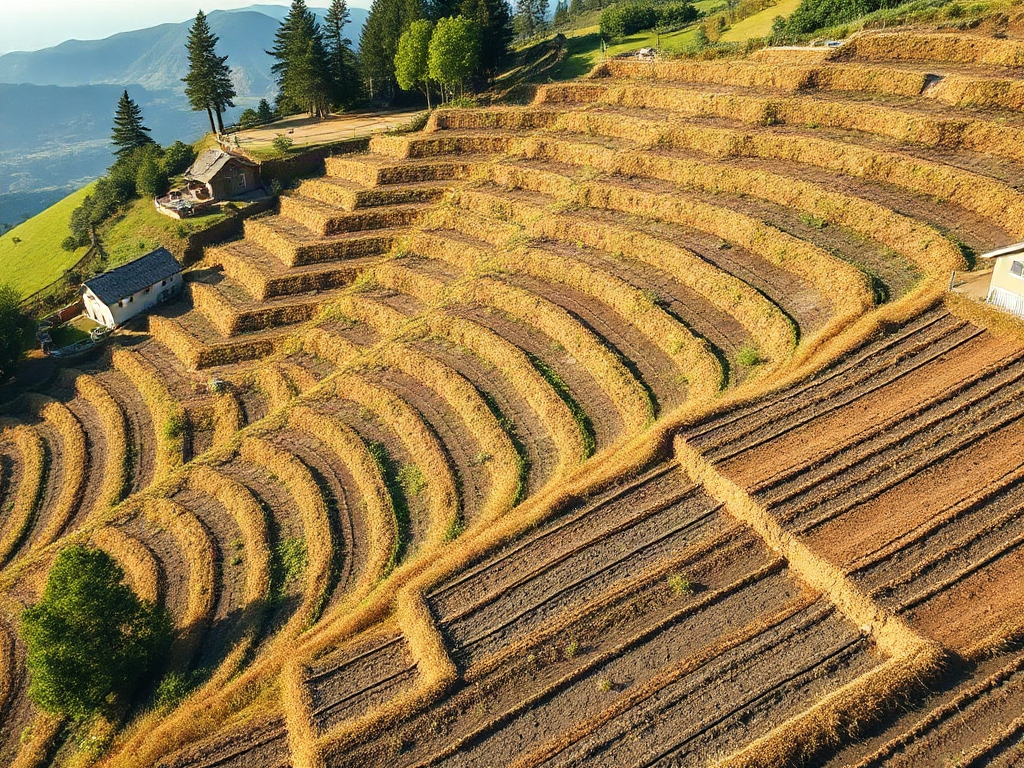
Contour farming versus terrace farming on slopes comes down to how much runoff control and earthwork the land requires: contour rows redirect and slow surface water, while terraces reshape the slope into engineered channels or steps. Contour farming generally suits moderate, workable slopes where established vegetation, stable outlets, and correctly marked elevation lines can limit erosion. Terraces may be justified where long or steeper slopes generate runoff that contour rows cannot safely manage, but they cost more and require careful drainage design. Rills crossing rows, overtopped channels, slumping banks, and sediment at slope outlets indicate that the chosen system is failing.
How Contour Rows and Terraces Control Runoff
Contour rows interrupt downhill water movement without substantially rebuilding the hillside. Planting rows, shallow cultivation marks, perennial strips, or small ridges follow lines of equal elevation across the slope. Each line creates resistance that slows runoff, encourages infiltration, and reduces the distance water can accelerate before meeting another obstruction. The field remains sloped, so the method depends on continuous surface cover and correctly aligned rows rather than large earth structures.
A contour line is not simply a row that appears to run sideways across a hill. A row that gradually drops toward one end can collect and accelerate water like a drain. During a heavy storm, that unnoticed grade may concentrate runoff at a low spot, cut through the row, and send sediment downslope. Accurate layout with a laser level, survey level, water level, or carefully calibrated A-frame is therefore more important than making the rows look straight.
Terraces alter the slope more aggressively. A broad-based agricultural terrace usually combines a ridge with a shallow channel that intercepts runoff and carries it along a controlled grade toward a protected outlet. Bench terraces create more distinct, step-like surfaces and require substantially more excavation, bank stabilization, and drainage planning. Both forms shorten the effective slope length, but neither makes water disappear. The intercepted flow still needs a destination that will not erode.
Consider a cultivated hillside where runoff travels uninterrupted for a long distance. Contour rows divide that flow path into smaller sections, but water may still cross them if the ridges are low, compacted, or bare. A properly designed terrace captures more of the accumulating flow and routes it to a grassed waterway or another stable discharge point. That added control is useful, but a blocked terrace outlet can create ponding, overtopping, and a concentrated breach that causes more damage than diffuse sheet flow.
The practical distinction is between slowing water where it falls and collecting water for managed release. A contour farming versus terrace farming on slopes decision should begin with that hydraulic difference, not with the visual appearance of the finished field. Contour methods are lighter interventions with fewer structural risks. Terraces offer stronger interception where justified, but their channels, embankments, and outlets become infrastructure that must continue working through storms and cultivation.
Which Method Fits the Slope and Field
Slope percentage alone does not determine the right treatment. Slope length, soil infiltration, erosion history, rainfall intensity, machinery access, intended land use, and the condition of the outlet all change how runoff behaves. A short, well-covered incline may respond well to contour cultivation, while a long slope of the same steepness can accumulate enough water to overwhelm shallow rows. Bare or compacted ground likewise produces faster runoff than soil protected by dense vegetation and residue.
Contour farming is often the lower-disruption choice for moderate slopes that can be cultivated safely across the hill. It works particularly well as part of a combined system that includes cover crops, residue retention, reduced tillage, perennial contour strips, and protected drainage paths. Those supporting practices reduce both runoff volume and the amount of loose soil available for transport. Contour alignment by itself is a weak defense when the spaces between rows remain bare for extended periods.
Terraces become more relevant when runoff repeatedly crosses contour rows, the uninterrupted slope is long, or existing gullies show that water is concentrating beyond what small ridges can handle. They may also create more workable field segments on land where equipment would otherwise travel unsafely up and down the grade. That does not make every steep hillside a terrace candidate. Very shallow soil, unstable subsoil, seepage, buried utilities, or inadequate outlet space can make excavation difficult or hazardous.
A useful field assessment separates visible symptoms from their causes:
- Sheet erosion: thin layers of soil move broadly downslope, suggesting a need for better cover and shorter runoff paths.
- Rills crossing rows: concentrated flow is defeating the contour pattern or entering from land above.
- Persistent wet pockets: poor drainage, seepage, or an incorrect grade may make either cultivation or terrace banks unstable.
- Gullies at field edges: collected water lacks a protected outlet, so adding more interception without fixing the discharge point may worsen damage.
For example, a small market garden on a moderate incline may gain more from permanent grass strips, mulched beds on surveyed contours, and a stabilized lower boundary than from major excavation. A longer cropped field with repeated cross-slope rills may need professionally designed broad-based terraces linked to a grassed waterway. Grazed land may call for yet another emphasis: maintaining dense pasture and managing livestock traffic could address runoff more effectively than cutting cultivation terraces into ground that does not need row cropping.
Choose according to the weakest part of the water path. If surface cover is poor, repair that deficiency before assuming earthwork is the answer. If runoff arrives from a road, roof, or uphill parcel, control that inflow separately. If the proposed terrace has nowhere safe to discharge, the design is incomplete. Local conservation professionals or qualified agricultural engineers can evaluate soil, grade, expected flow, and outlet capacity before permanent structures are built.
Layout, Construction, and Drainage Priorities
Field layout should start with observation and measurement rather than immediate digging. Walk the site after rain and mark where water enters, spreads, ponds, cuts rills, and leaves. Note exposed subsoil, sediment fans, wet banks, springs, and wheel tracks that act as channels. A topographic survey provides the clearest basis for structural work, while simple leveling tools can help a small grower locate preliminary contour lines for low-risk beds or vegetation strips.
True contour lines remain level, but farm layouts often need slight, controlled grades to move surplus water toward an outlet. That distinction requires care. A level vegetated strip is intended mainly to slow and spread flow; a graded terrace channel intentionally conveys it. Guessing at either alignment can send too much water to one end. Permanent terraces should follow a site-specific design that accounts for channel capacity, ridge dimensions, soil behavior, farm equipment, and a non-eroding discharge route.
A practical planning sequence is:
- Map the entire drainage area. Include water arriving from above the cultivated plot, not only rain falling within it.
- Test the proposed alignment. Mark elevations, inspect low points, and confirm that machinery can turn and operate without crossing structures repeatedly.
- Secure the outlet first. Establish a stable grassed waterway or another suitable discharge area before directing additional flow toward it.
- Protect disturbed ground. Seed, mulch, or otherwise stabilize exposed soil promptly, especially around terrace outlets and newly shaped banks.
- Inspect during early storms. Correct minor ponding, settlement, or concentrated flow before it develops into a breach.
Contour systems also need operational discipline. Rows can drift away from the surveyed line as operators follow old wheel tracks or straighten turns for convenience. Successive passes may create low points that funnel water through the field. Permanent reference stakes, mapped keylines, or established grass strips make the intended alignment easier to preserve between seasons. Narrow turns and awkward point rows should be planned deliberately rather than improvised during planting.
Terrace construction presents higher consequences. Excavation can expose erodible subsoil, place unsuitable material in an embankment, or create steep faces that slump when saturated. Heavy equipment may compact the channel and adjacent growing area, reducing infiltration even while the structure redirects runoff. Bench terraces can also need retaining support or carefully stabilized risers; treating them as oversized garden beds understates the forces acting on saturated earth.
The safest approach is proportional intervention. Use surveyed contour beds and vegetated barriers where shallow surface control is adequate. Seek local technical design for structures that collect appreciable runoff or could release water toward buildings, roads, neighboring property, wells, or unstable ground. Additional layout considerations in contour farming versus terrace farming on slopes should never replace an on-site assessment when a structure’s failure could damage land beyond the field.
Costs, Maintenance, and Failure Signs
Contour farming usually carries lower initial costs because it changes field direction and surface treatment rather than moving large volumes of earth. Expenses may include surveying tools, permanent markers, grass-strip establishment, revised fencing, and extra time for irregular turns. The less obvious cost is reduced operational convenience: point rows, short passes, and cross-slope travel can complicate cultivation. On ground too steep for safe equipment operation, low construction cost does not make contour cropping appropriate.
Terraces demand excavation, grading, stabilization, and dependable outlets. They may remove some area from annual production and can constrain equipment width or turning space. Broad-based terraces are often farmed over, but repeated tillage can gradually flatten the ridge and fill the channel. Bench terraces create distinct platforms, yet their risers occupy space and need durable cover. Repair costs rise sharply if delayed maintenance allows a small low spot to become an overtopping point.
Routine inspection should occur after intense rain and before field operations. On contour ground, look for fresh rills, sediment piled against grass strips, rows that have settled, and water entering from an unplanned direction. A working system shows broadly distributed residue, limited sediment movement, intact vegetation, and no single pathway cutting through multiple rows. Failure appears as repeated breaks at the same locations, exposed roots, muddy runoff leaving the field, or deposits accumulating at the foot of the slope.
Terraces require attention to both channel and embankment. Remove obstructions without stripping protective vegetation, repair animal burrows, and watch for wheel ruts that divert flow over the ridge. Ponded water may indicate settlement or a blocked outlet. Bare patches, cracks, bulges, seepage on a bank face, or slumped soil warrant prompt evaluation because they can signal instability rather than ordinary surface erosion. Raising a low section casually may shift water elsewhere instead of correcting the underlying grade.
A common budgeting mistake is comparing annual contour work with terrace construction while ignoring lifetime upkeep. Contour systems need recurring alignment, cover management, and occasional reshaping. Terraces can last for years when properly designed and maintained, but they remain drainage structures rather than one-time landscaping. Access for inspection and repair should be included in the original layout.
Measure performance by what happens during runoff, not by how neat the rows look in dry weather. Photograph fixed locations after storms, mark recurring rills, and note whether sediment is moving past each barrier. If failures persist, reassess runoff entering from above, soil cover, outlet capacity, and alignment before making ridges taller. Combining contour rows with perennial strips may solve a surface-erosion problem; concentrated flows or unstable banks may require advice from a local conservation office or a qualified designer.
Frequently Asked Questions
Is contour farming the same as terracing?
No. Contour farming follows equal-elevation lines while retaining the general hillside shape. Terracing uses constructed ridges, channels, or stepped surfaces to shorten and manage the slope more substantially.
Can contour rows be used on steep land?
They may be unsafe or inadequate on steep, long, unstable, or highly erodible slopes. Ground cover, equipment safety, runoff concentration, and local technical guidance matter more than a single universal slope limit.
Do terraces hold all rainfall on the hillside?
No. Many terraces intercept runoff and convey excess water toward a protected outlet. Blocking the outlet or assuming the terrace stores unlimited water can lead to ponding and overtopping.
What is the first sign that a contour layout is wrong?
Water repeatedly running along a row, pooling at one end, or cutting across several rows suggests an incorrect grade, a low point, or more incoming runoff than the layout can spread safely.
Can a small homestead build terraces without professional help?
Small, low-risk garden shaping differs from a structure that intercepts substantial runoff. Seek site-specific technical help when failure could affect buildings, roads, wells, neighboring land, or unstable slopes.
Conclusion
Base the choice on water movement across the whole hillside, including runoff that enters from roads, roofs, and land above the field. Contour rows are the lighter intervention where measured alignment, protective cover, and stable flow paths can interrupt surface erosion. Terraces are permanent drainage infrastructure suited to situations that require stronger interception, provided their channels, banks, and outlets are properly designed.
Before changing the slope, observe it during rain, map erosion and ponding, verify grades, and identify a safe outlet. Begin with cover improvement and the least disruptive treatment capable of handling the problem. Inspect every system after major runoff events. Repeated rills, muddy discharge, overtopping, seepage, or slumping are reasons to reassess the design rather than simply rebuild it higher.