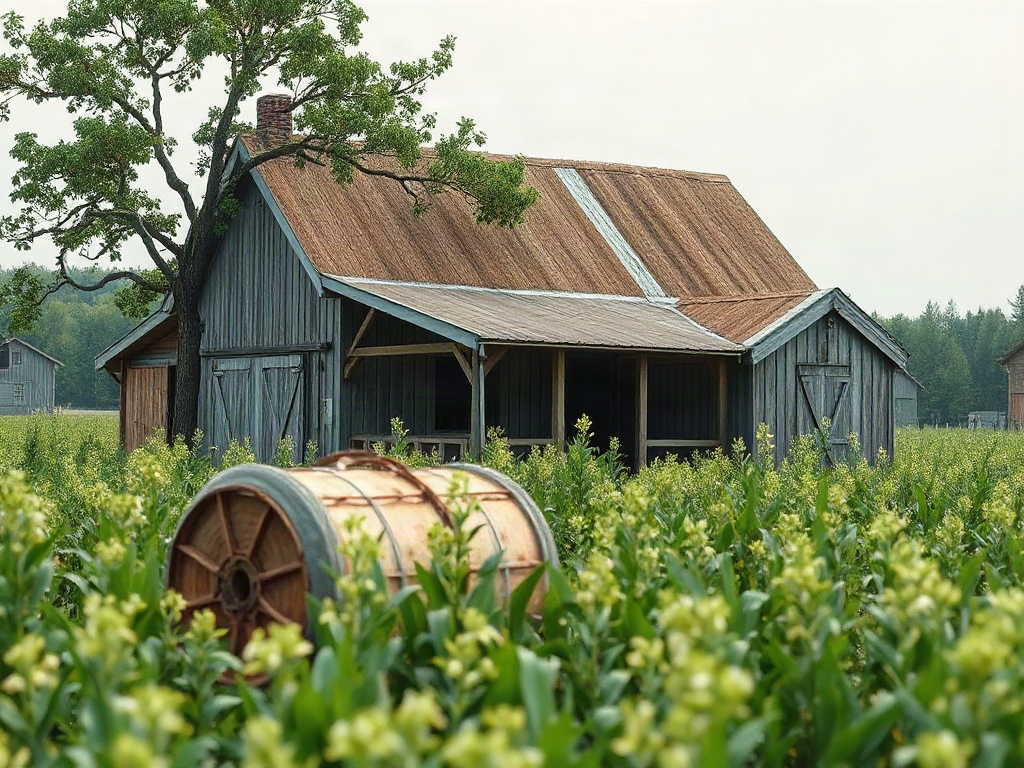
Plantation farming is a large-scale agricultural system in which an estate concentrates land, labor, and capital on one or a few commercial crops, usually for processing and export. Its historical context is inseparable from European colonial expansion, coerced labor, and the enslavement of Africans, especially in sugar, tobacco, and cotton regions. Plantations differed from ordinary large farms because they often combined centralized management, worker housing, crop processing, and access to distant markets. After emancipation, many estates continued through wage labor, tenancy, indenture, or contract systems.
What Defines a Plantation System?
A plantation is defined more reliably by its organization than by acreage alone. The classic system placed a substantial area of land under centralized control, specialized in a profitable commodity, assembled a large labor force, and connected production to processing and distant markets. Sugar estates might include cane fields, mills, boiling houses, storage facilities, worker quarters, and shipping connections. That integrated structure made the plantation an agricultural enterprise and a controlled social environment.
Crop specialization was usually central. Sugarcane, tobacco, cotton, coffee, tea, bananas, cacao, rubber, and indigo became plantation commodities in different regions and periods. These crops were attractive to investors because they could command commercial value beyond the place where they were grown. Many also required coordinated planting, harvesting, or processing. Cut sugarcane, for example, deteriorates quickly, so estates benefited from controlling both the fields and a nearby mill.
Not every property called a plantation had every feature, and local usage varied. A large grain operation employing paid seasonal crews may be a commercial farm without being a plantation in the historical sense. Conversely, an estate could remain plantation-like after being divided into managed units if processing, labor supervision, credit, and marketing remained concentrated. Size matters, but it does not settle the classification.
A useful identification checklist asks whether the operation had:
- centralized ownership or managerial control over extensive land;
- one dominant cash crop or a narrow group of export commodities;
- a dependent, tightly controlled, or unusually large workforce;
- on-site or closely linked processing and storage;
- strong ties to merchants, ports, imperial trade, or international buyers.
The common mistake is to treat plantation as a decorative synonym for a spacious farm or historic house. That usage hides the productive system surrounding the residence, including fields, work sites, transport routes, and laborers’ living spaces. When evaluating a particular site, prioritize ownership records, crop accounts, labor arrangements, and processing infrastructure over architecture or acreage. Those details reveal how the operation actually functioned.
How Did Colonial Expansion Shape Plantations?
European colonial expansion helped turn plantations into major engines of Atlantic and global commerce. Colonial governments and investors claimed or redistributed land, promoted export crops, and built legal and military systems that protected property and trade. Plantations supplied distant consumers and manufacturers rather than primarily feeding nearby households. Their expansion therefore depended on ships, credit, insurers, merchants, ports, and political power as much as on fertile ground.
Sugar offers a clear example. Cultivation moved through Mediterranean and Atlantic island settings before becoming deeply established in the Caribbean and parts of the Americas. Producing refined sugar demanded land, mills, fuel, technical knowledge, and intense labor scheduled around harvest and crushing. Investors could combine these elements on an estate, while colonial trade networks carried the finished commodity abroad. Similar structures developed around tobacco in the Chesapeake, cotton in the southern United States, coffee in Brazil and the Caribbean, and tea or rubber in parts of Asia.
Environmental suitability influenced where a commodity could grow, but climate alone does not explain plantation geography. Colonial authorities granted land, displaced Indigenous communities, restricted workers’ movement, and directed infrastructure toward export corridors. A favorable growing region without secure investor control, abundant labor, or access to shipping was less likely to become a major plantation zone. Political choices converted ecological potential into an extractive production system.
Plantations should not be confused with all colonial agriculture. Smallholders, Indigenous producers, pastoral communities, tenant farmers, and mixed subsistence holdings existed alongside estates. Some small growers even supplied plantation-owned mills or merchant networks. The distinction lies in who controlled land, processing, labor, credit, and market access. A household producing several foods for local use occupied a very different economic position from an estate directing hundreds of workers toward one export crop.
For practical historical research, follow the commodity from field to buyer. Check who owned the land, who financed planting, where processing occurred, how labor was obtained, and where the product was sold. This method prevents a weak assumption that plantations arose simply because a crop grew well. It exposes the institutions that made concentrated production possible and identifies who captured the resulting value.
Why Is Labor History Central to the Definition?
Labor control was a structural requirement of many historical plantation economies, not a secondary detail. Labor-intensive crops had to be planted, tended, harvested, and processed according to commercial schedules. Estate owners sought a workforce they could command consistently and inexpensively, often under conditions that denied workers meaningful freedom. The particular system varied by place and period, but coercion repeatedly supported plantation profitability.
In much of the Americas, plantation development became inseparable from the transatlantic trafficking and enslavement of Africans and their descendants. Enslaved people cultivated crops, maintained livestock, practiced skilled trades, processed commodities, transported goods, and sustained the domestic operations of estates. Their legal treatment as property enabled owners to claim both their labor and, under hereditary slavery, that of future generations. Violence, surveillance, family separation, and restrictions on movement upheld this arrangement.
Plantation labor was never a single uniform experience. Work differed by crop, task, gender, age, season, estate, and legal regime. Sugar milling imposed different hazards and schedules from cotton picking or coffee harvesting. Enslaved people also resisted through escape, revolts, work slowdowns, preservation of family and cultural life, negotiation, and other strategies. A history focused only on owners’ production totals misses both the human cost and the agency of those forced to sustain the system.
Elsewhere, and especially after legal slavery ended, plantations used indentured laborers, contract workers, tenants, sharecroppers, migrant crews, or people constrained by debt and discriminatory laws. These arrangements were not identical to chattel slavery and should not be collapsed into one category. The useful comparison examines specific freedoms: Could workers leave, own property, keep their families together, negotiate pay, challenge abuse, or choose what to grow? Legal labels alone may conceal substantial economic dependence.
A frequent interpretive failure is to discuss a plantation’s crop, mansion, or owner’s biography while describing workers only as a labor supply. Better analysis uses estate accounts alongside census material, testimony, archaeology, legal records, family histories, and records created by formerly enslaved or indentured people. These sources may conflict or contain gaps, but reading across them produces a more accurate picture than relying on the estate’s own bookkeeping and promotional claims.
How Did Plantation Systems Change After Emancipation?
Emancipation changed the legal basis of plantation labor, but it did not automatically redistribute land, machinery, credit, or political influence. Formerly enslaved people sought autonomy, family security, education, land, and control over their time. Estate owners, meanwhile, often tried to preserve export production and access to a dependable workforce. The resulting systems differed across regions because laws, labor supplies, commodity prices, and political struggles were not uniform.
Some plantations hired wage workers. Others leased plots, used sharecropping or tenancy, recruited indentured migrants, or tied workers to estate stores and housing. In the Caribbean, plantation owners and colonial authorities brought indentured workers from India and other regions after emancipation. In the post-Civil War American South, sharecropping and crop-lien arrangements often left Black farmers and poor white farmers dependent on landowners and merchants. Neither example recreated slavery exactly, but both could preserve unequal control over land and income.
Continuity and change must therefore be evaluated separately. A worker might gain legal personhood and the formal ability to make a contract while still facing restricted mobility, debt, racial discrimination, or few alternative employers. An estate might cease housing a permanently bound labor force yet retain its mill, export connections, and dominance over surrounding growers. Looking only for the end of a legal institution can obscure the survival of its economic infrastructure.
Plantation regions also changed when commodity markets weakened, soils declined, estates were subdivided, land reform occurred, or political conditions shifted. Some properties became smaller farms, tourist sites, conservation areas, or residential developments. Others continued producing the same crop under corporate ownership. A surviving mansion does not prove that the full production system remained intact, just as the disappearance of estate buildings does not erase earlier labor and land relations.
When tracing a property’s transition, compare records from before and after the legal change. Check whether ownership fragmented, workers acquired land, housing arrangements changed, wages replaced rations, independent growers gained access to processing, and production diversified. Signs of genuine structural change include broader land access and greater worker bargaining power. Continued dependence on one landlord, mill, creditor, or buyer suggests that substantial parts of the old hierarchy endured.
How Should the Term Be Interpreted Today?
Modern use of the word plantation requires attention to geography, industry, and historical setting. The term may describe a historical estate shaped by slavery, a current tropical export enterprise, or a deliberately planted stand of trees. A forestry plantation, for example, refers to trees established and managed for timber, pulp, rubber, or another product; the label does not by itself establish a connection to enslaved labor. Context determines what the word communicates.
Large contemporary estates may retain familiar economic traits: crop specialization, centralized management, processing facilities, hired workforces, and dependence on international commodity prices. Yet modern labor law, ownership structures, mechanization, certification programs, and supply chains create important differences from colonial plantations. Calling every large monoculture a plantation can flatten those distinctions. Refusing the term whenever it is uncomfortable can be equally misleading when historical records and local usage clearly identify a plantation system.
For homesteaders and small-farm readers, the plantation model is not a practical synonym for efficient growing. Homesteads generally benefit from diversified food production, flexible household labor, soil-building rotations, and reduced dependence on a single buyer. Plantation specialization could coordinate processing and lower unit costs, but it also exposed estates and workers to crop disease, soil exhaustion, market swings, and concentrated power. Scale may create efficiency without creating resilience or equitable control.
Use a three-part test when encountering the term today. First, establish the time and place. Second, identify the commodity and how land, labor, processing, and sales were organized. Third, determine whether the writer is using a historical, agricultural, forestry, architectural, or promotional meaning. If a heritage property advertises only gardens and a grand residence, consult archival and archaeological sources that also address work sites and labor communities.
Signs of sound interpretation include precise dates, named labor systems, clear distinctions between legal categories, and attention to people beyond owners. Warning signs include nostalgic language, passive phrases that hide who performed the work, or claims that all plantations operated identically. The strongest approach neither reduces the subject to acreage nor treats one regional example as universal. It connects physical production to the laws, markets, and human relationships that sustained it.
Conclusion
Plantation history becomes clearer when the estate is examined as a complete system rather than as a large field or prominent residence. Land concentration, commodity specialization, processing, labor control, and access to distant markets belong in the same analysis. Colonial rule and slavery were decisive in many regions, while indenture, tenancy, wage work, and debt-based dependence shaped later forms without being interchangeable.
When assessing a particular plantation, begin with its date, location, crop, ownership, and labor regime. Then trace who controlled processing, credit, transport, and sales. Give workers’ testimony, community history, and archaeology weight alongside estate accounts. That evidence-based approach distinguishes historical realities from nostalgic presentation and helps readers recognize both the transformations and the inequalities that persisted after emancipation.
Frequently Asked Questions
What is the simplest definition of plantation farming?
It is centralized, large-scale production of one or a few commercial crops using an organized workforce and often linked processing facilities, primarily to supply markets beyond the estate.
Is every large farm a plantation?
No. Acreage alone is insufficient. Historians also examine crop specialization, labor control, ownership, processing, worker housing, and connections to export or long-distance trade.
Were all plantations operated with enslaved labor?
No, but slavery was foundational to many plantation economies in the Americas. Other plantations used indentured, tenant, wage, migrant, or contract labor under widely differing conditions.
Which crops were commonly grown on plantations?
Historically important plantation commodities included sugarcane, cotton, tobacco, coffee, tea, cacao, rubber, bananas, and indigo. The dominant crop varied with climate, markets, and colonial policy.
Does plantation farming still exist?
Large estate-based production continues in some agricultural and forestry sectors, although ownership, technology, and labor rules differ from historical systems. Current conditions should be evaluated rather than inferred from the label.