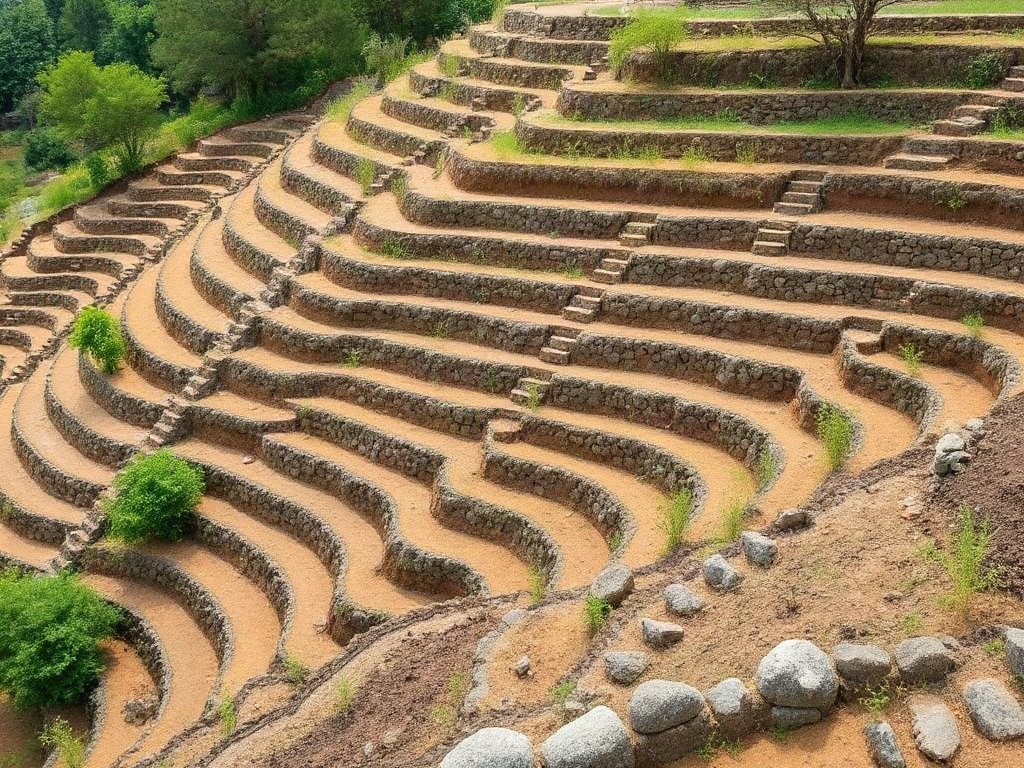
Maya terrace farming techniques controlled erosion by reshaping hillsides into stepped or gently sloping plots that slowed runoff, trapped sediment, and retained cultivable soil behind stone or earthen barriers. Builders generally followed local contours, stabilized terrace faces, and provided routes for excess water rather than attempting to stop drainage completely. Terrace fills could deepen planting zones and moderate soil-moisture loss, while vegetation helped bind exposed surfaces. The system worked only when walls, outlets, and accumulated sediment were maintained; blocked drainage or neglected breaches could concentrate water and accelerate slope failure. Archaeological evidence also shows regional variation, so Maya terraces should not be treated as one standardized design.
How Maya Terraces Changed Hillside Water Flow
Maya farmers altered slopes so rainfall crossed shorter, flatter surfaces instead of gathering speed over an uninterrupted hillside. On an unmanaged incline, moving water can detach fine particles, carry organic matter downhill, and carve channels that become deeper during later storms. A sequence of terrace treads interrupted that movement. Each tread reduced the effective slope length, while its outer edge caught sediment that otherwise would have left the cultivated area.
The terraces were not identical throughout the Maya region. Archaeologists have documented stone-faced forms, earthworks, contour-aligned features, and closely spaced terrace systems suited to different combinations of bedrock, rainfall, soil depth, and settlement pressure. Some supported cultivation, while other terraced features may have served water management, residential, or mixed purposes. Calling every stone line on a slope an agricultural terrace can therefore produce a misleading picture. Location, associated soils, construction details, and evidence of cultivation all matter when interpreting a feature.
Effective erosion control came from slowing water without creating a permanently saturated platform. Rain striking a terrace could infiltrate the tread, spread laterally, or pass through a controlled outlet. Sediment settled where flow velocity dropped. Over time, this process could conserve existing topsoil and add fine material behind a terrace edge. It could also create a deeper rooting zone than the original shallow slope offered, although the result depended on stable fill and adequate drainage.
A useful comparison is a bare hillside crossed by a straight path. The path can act like a chute because it runs downhill and concentrates runoff. A contour-aligned terrace does the opposite: it breaks the downhill route and distributes water across the slope. Yet a perfectly level, sealed terrace can hold too much water during intense rain. The practical principle is controlled movement, not total impoundment.
Readers studying Maya terrace farming techniques for erosion control should notice the combined effect of slope shortening, rough surfaces, sediment capture, and safe overflow. A wall by itself is not the complete system. The tread, foundation, soil cover, vegetation, and discharge route determine whether that wall reduces erosion or merely relocates it.
Terrace Layout, Walls, and Soil-Fill Construction
Terrace placement worked best when it responded to the hill’s contour and underlying ground rather than forcing equal-width steps across variable terrain. A contour line joins points at the same elevation, so a barrier following it spreads runoff instead of directing water toward one low corner. Irregular slopes often require changing the tread width, wall height, or spacing. Closer spacing may be needed on a steeper section, while a gentler shoulder can accommodate a broader cultivated surface.
Stone-facing was especially practical where limestone or other local rock was readily available. A retaining face held soil and fill in place, but stability depended on more than stacking visible stones. The lowest course needed firm support, larger pieces were useful near the base, and the wall could not safely function as a watertight dam. Voids within carefully placed dry stone allowed limited seepage, reducing pressure behind the face. Earthen terraces relied more heavily on compacted banks, roots, and shallow grades, making protective vegetation particularly important.
Fill quality affected both cultivation and structural performance. Loose organic debris settles as it decays, leaving depressions and stressing the retaining edge. Fine clay packed against a wall can impede drainage and increase pore-water pressure. A more stable profile uses mineral soil and stone in the structural zone, with productive topsoil reserved for the planting layer. Archaeological terrace fills were not necessarily assembled according to one recipe, but the physical distinction between stable support and fertile surface soil remains useful.
Consider a homestead slope where shallow soil lies over irregular bedrock. Building one tall wall at the bottom may appear economical, yet it places a large soil mass and substantial water pressure behind a single structure. Several low contour steps distribute that load and shorten runoff paths. They also demand more layout work and more total edge construction. The tradeoff is between concentrated structural risk and the labor required to create multiple modest platforms.
A compact layout check should include:
- Contour: Confirm elevation along each proposed edge rather than judging by sight.
- Foundation: Remove loose organic material and identify unstable or undermined ground.
- Fill: Keep decaying brush and uncompacted pockets out of structural zones.
- Outflow: Identify where exceptional rainfall can leave without cutting through the wall.
- Access: Avoid creating footpaths or wheel tracks that send water straight downhill.
The common failure is treating a retaining wall as a decorative boundary. Terrace construction changes the load, moisture, and runoff pattern of the entire slope. On a steep, high, or already unstable site, modern engineering assessment is more appropriate than direct imitation of an archaeological form.
Drainage and Maintenance That Kept Terraces Stable
Drainage determined whether a terrace remained an erosion-control feature or became a saturated mass pressing against its outer face. Water entering the tread needed opportunities to soak into suitable soil, move slowly through permeable material, or exit at a protected location. If the fill became sealed or an outlet clogged, pressure could dislodge stones, slump the bank, or cut a new channel around the end of the terrace.
Overflow deserves special attention because average rainfall does not reveal how a system behaves during a concentrated storm. Water often finds the lowest point, including an accidental dip caused by settlement, animal traffic, or repeated cultivation. Once flow overtops an unprotected wall, it can remove supporting soil and enlarge the breach quickly. A deliberately selected spill area should lead onto stone, dense vegetation, or another non-erodible surface rather than bare fill.
Terraces also need maintenance from one level to the next. Suppose sediment accumulates against the upper side of a tread. That deposition shows the terrace is intercepting material, but it may also change the grade and redirect future water toward one end. Redistributing the deposit can restore a gentle surface. Conversely, fresh sediment below a wall, bulging stones, persistent wet patches, or a widening crack on the tread can indicate movement rather than successful capture.
Vegetation adds a living layer of protection. Roots reinforce near-surface soil, stems interrupt shallow flow, and leaf cover reduces direct impact from rain. Crops alone may leave the ground exposed between rows or after harvest, so terrace edges benefit from perennial cover suited to the climate and rooting space. Large woody plants immediately beside a dry-stone face can be problematic if expanding roots displace masonry. Low, dense cover is usually easier to inspect and manage.
Maintenance priorities are easier to understand through signs rather than a calendar alone. A functioning terrace generally shows even infiltration, stable edges, limited rilling, and no persistent ponding after ordinary rain. Warning signs include:
- water repeatedly converging at one corner;
- new gullies above, below, or around terrace ends;
- stones rotating outward or soil leaking through the face;
- soft, saturated fill long after nearby ground has drained;
- bare traffic routes connecting several levels downhill.
Repair should address the water route before replacing displaced material. Restacking a wall while runoff continues to strike the same point only resets the failure. The enduring lesson from Maya terrace farming techniques for erosion control is that upkeep was part of the agricultural system, not an occasional cosmetic task.
Applying Maya Terrace Principles on Modern Homesteads
Modern homesteaders can apply the hydraulic principles of Maya terraces without attempting to reproduce an ancient structure exactly. The safest starting point is close observation of water during rain: identify where runoff begins, where it accelerates, which soils remain saturated, and where sediment is deposited. Dry-weather inspection alone can miss the channels that control actual erosion.
Begin with the least disruptive intervention that fits the slope. Gentle land may respond to contour planting, permanent groundcover, mulch held against movement, or shallow vegetated berms. Moderate inclines may justify low terraces when they can be built on stable ground with protected overflow. Tall retaining structures, slopes showing landslides, or sites above buildings and roads require professional evaluation because failure consequences extend beyond lost garden soil.
A small trial section provides better information than reshaping an entire hillside at once. Mark a contour with a water level, laser level, or survey equipment; establish one low step; protect its surface; and watch it through substantial rain. Check whether water spreads, ponds, bypasses the ends, or cuts through disturbed soil. Adjust spacing and drainage before extending the pattern. This staged approach costs time but limits the damage caused by a mistaken grade.
Crop choice should follow the terrace’s soil depth and moisture behavior. A shallow tread over rock cannot support the same root volume as a deeper filled platform. Plants needing frequent cultivation may expose soil repeatedly, while perennial or densely spaced plantings keep more protective cover. Paths should run along contours or use armored transitions between levels. A straight unprotected stairway can undo the terraces by becoming the fastest downhill drainage route.
Imported stone, machinery access, and labor can make a historically inspired design unnecessarily expensive. Where local rock is scarce, a well-vegetated earthwork may be more practical than a stone face, provided the bank remains low and stable. Where rainfall is intense or soil drains poorly, terraces alone may be unsuitable unless water can be discharged safely. Historical precedent does not cancel modern site constraints.
Judge success by soil retention and water behavior, not by how closely the finished slope resembles an archaeological illustration. Stable surfaces, protected outlets, retained mulch, clear water leaving the site, and vigorous cover indicate useful performance. Recurrent muddy discharge, wall movement, buried outlets, or expanding wet areas call for immediate reassessment. The transferable value of the Maya example lies in contour-sensitive land shaping and continuous care, not in copying a single wall profile.
Frequently Asked Questions
Did all Maya farmers use the same terrace design?
No. Terrace forms varied with slope, local stone, soil depth, rainfall, settlement patterns, and intended land use. Archaeological interpretation must distinguish cultivated terraces from other constructed features.
How did Maya terraces reduce erosion?
They shortened uninterrupted slopes, slowed surface flow, encouraged sediment deposition, and retained soil behind stone or earthen edges while allowing excess water to move through controlled routes.
Were Maya terraces designed to hold all rainfall?
No. Completely trapping water could saturate the fill and threaten the retaining face. Infiltration, seepage, and protected overflow were necessary parts of stable water management.
Can Maya terrace ideas be used in a home garden?
The underlying principles can be adapted through contour planting, low terraced beds, permanent cover, and protected drainage. Steep slopes or tall retaining walls require site-specific professional advice.
What is the clearest sign that a terrace is failing?
Bulging edges, displaced stones, persistent saturation, fresh cracks, concentrated overflow, and sediment appearing below the wall all warrant attention. Repair the water pathway before rebuilding the damaged section.
Conclusion
Maya hillside management offers a practical lesson in working with terrain rather than treating a slope as a flat field. The strongest systems combined contour-aware placement, stable retaining edges, cultivable fill, protective vegetation, and an outlet for exceptional rainfall. None of those elements compensates indefinitely for failure in another.
For a modern site, map runoff before moving soil, favor several low interventions over one high unsupported wall, and test a limited area through wet weather. Inspect for ponding, rills, displaced material, and runoff bypassing terrace ends. If the slope is steep, visibly unstable, or capable of threatening structures below, pause the project and obtain qualified site advice. Ancient principles are most useful when adapted to present soil, rainfall, access, and safety constraints.