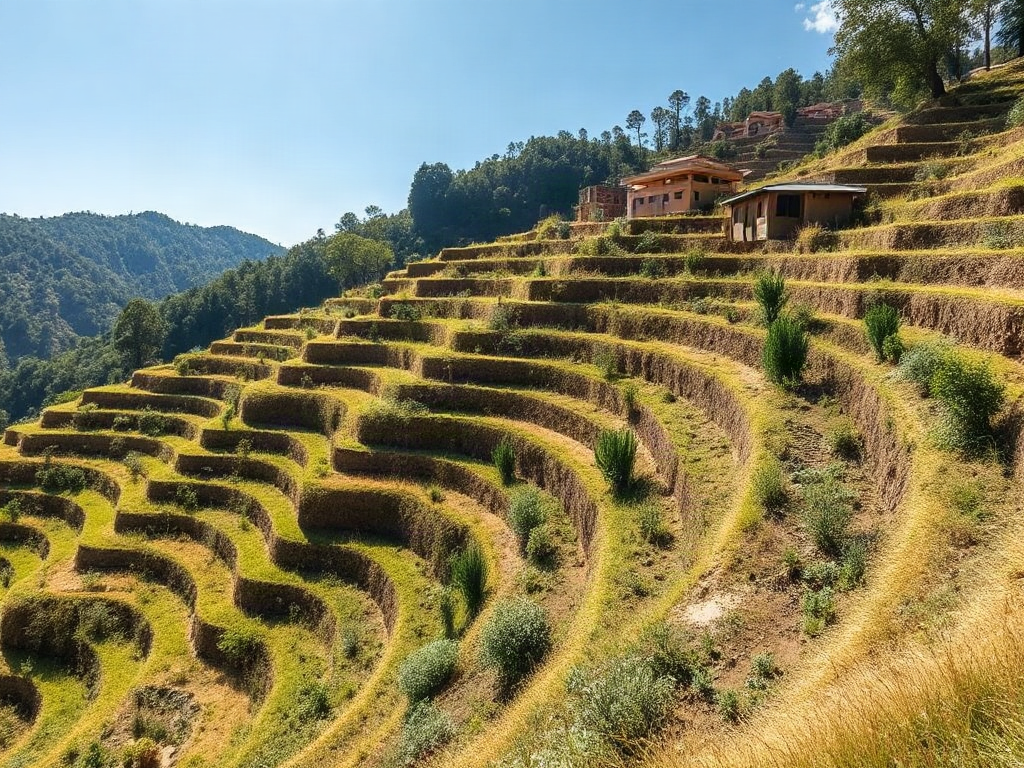
Terrace farming supported ancient communities by converting steep slopes into level planting areas that retained soil, slowed runoff, managed irrigation, and expanded the land available for crops. Stone or earthen retaining walls reduced erosion while channels directed water between fields, helping farmers cope with mountainous terrain and uneven rainfall. Terraces also created distinct growing conditions at different elevations, allowing communities to cultivate crops suited to local soils and temperatures. Their value depended on sustained communal labor: damaged walls, blocked drains, or neglected channels could cause soil loss and terrace failure. The system therefore supported both food production and the cooperative institutions needed to maintain fields across generations.
Turning Steep Slopes Into Productive Fields
Mountain slopes offered ancient farmers sunlight, drainage, and access to different elevations, but their natural angle made cultivation difficult. Rain could carry loosened soil downhill, planting surfaces were narrow, and people had little room to use ordinary level-field methods. Terracing changed the shape of the slope itself. Farmers cut a series of steps into the hillside, supported each step with stone or compacted earth, and filled or leveled the space behind the retaining wall.
The resulting benches were easier to plant, weed, and harvest than an untreated incline. A terrace did not make the land perfectly flat in every case; a slight inward or lateral grade often helped move excess water toward a drain or channel. The important change was a reduction in slope length. Water no longer gathered speed across one long hillside because each bench interrupted its path.
Construction methods reflected the materials and pressures of a particular place. In stone-rich mountain regions, carefully fitted walls could withstand repeated wetting and soil pressure. Elsewhere, shaped banks of earth were more practical but required frequent repair. Some terraces were narrow strips suited to hand cultivation, while others formed broad fields. The basic principle remained consistent: reshape difficult terrain into a sequence of manageable planting surfaces.
Terraces also expanded food-producing land near established settlements. Without them, communities might have depended more heavily on distant valleys or scattered patches of gentle ground. Bringing slopes into cultivation could shorten travel between homes, fields, water sources, and storage areas. That advantage came with a major cost, however. Excavating benches, moving stones, transporting fill, and stabilizing walls demanded substantial labor before the first crop was harvested.
A common misconception is that every stepped hillside was built solely to increase acreage. Some structures managed water, marked boundaries, supported paths, or protected settlements as well as crops. Archaeologists therefore examine retaining walls, soils, channels, plant remains, and settlement patterns together. Readers studying How terrace farming supported ancient communities should treat terraces as parts of larger landscapes rather than isolated agricultural inventions.
Controlling Water, Runoff, and Soil Loss
Water management determined whether a terrace remained productive or became unstable. A well-built bench slowed rainfall long enough for some moisture to enter the soil, while drains and channels carried excess water away before it saturated the retaining wall. This balance was more useful than simply trapping all available water. Waterlogged soil becomes heavy, and pressure behind a wall can push stones outward or open a breach.
On irrigated terraces, communities could divert water from springs, streams, canals, or higher fields. Distribution channels carried it across a contour, and smaller openings admitted controlled flows onto individual plots. Surplus water then moved toward a protected outlet or a lower terrace. This arrangement allowed farmers to use gravity rather than lifting water across large elevation changes, although upper fields and households controlling canal entrances could have gained practical influence over allocation.
Terraces reduced erosion through several linked mechanisms. Shorter slopes slowed surface flow, retaining walls caught displaced sediment, and cultivated soil remained concentrated on the bench instead of washing into a valley. Plant roots and maintained field edges added stability. These protections were not automatic. Bare soil, clogged drains, livestock damage, poorly bonded stonework, or an intense storm could cut channels through a bench and send both water and sediment onto the fields below.
Imagine a hillside receiving a hard seasonal rain. On an untreated slope, runoff may accelerate downhill and carve through recently worked ground. On a maintained terrace, the same flow is divided among several short surfaces and guided toward intended outlets. If an outlet is blocked, however, the terrace can concentrate water at its weakest point. The structure succeeds because farmers inspect the entire water route, not because the wall alone stops erosion.
A useful maintenance priority can be expressed as a short sequence:
- Clear channels and outlets before the rainy or irrigation season.
- Check walls for bulging, gaps, and displaced capstones that may reveal pressure or undermining.
- Replace lost soil and protect exposed surfaces before runoff forms a deeper cut.
- Repair upper terraces first when their failure could damage several levels below.
This sequence helps explain why water control was inseparable from social organization. A neglected upstream channel could threaten fields belonging to multiple households, so maintenance decisions had consequences beyond one plot.
Supporting Diverse Crops and More Reliable Harvests
Terraced landscapes gave farmers access to several small growing environments within the same mountain system. Elevation, slope orientation, soil depth, drainage, sunlight, and exposure to wind could vary from one bench to another. Ancient growers could respond by placing crops where conditions were most suitable rather than treating the entire hillside as a uniform field.
In the Andes, terraced cultivation formed part of agricultural systems that included crops such as potatoes, maize, and quinoa, with suitability varying by altitude and local climate. In parts of Asia, flooded terraces became closely associated with rice where dependable water and soils capable of holding it made that approach workable. Mediterranean hillsides supported dryland crops, including grapes and olives, on terraces adapted to different rainfall patterns. These examples share an engineering concept, but they should not be treated as identical systems.
The distinction matters because terraces did not guarantee abundant harvests. A flooded rice bench needs controlled ponding and a reliable water supply; a dry stone terrace for perennial crops needs drainage and wall stability. Applying one model to the other would ignore the crop, soil, and rainfall conditions that shaped construction. Even within a single community, some benches may have been intensively irrigated while others depended on seasonal precipitation.
Dividing production among elevations could also reduce exposure to a localized setback. Frost might damage one level while leaving a warmer plot lower on the slope less affected. A drainage problem could harm a wet bench without destroying every field. This did not eliminate famine, drought, pests, conflict, or crop failure, but it gave communities more ways to distribute production across varied conditions. Storage, exchange, herding, and valley agriculture often complemented terrace harvests.
Soil fertility still required active attention. Harvesting removes nutrients, and thin mountain soils can lose productive capacity if organic residues are burned, washed away, or continually exported. Depending on local practices, farmers could return crop residues, manure, household organic material, or fresh sediment to fields. A terrace showing declining yields, crusted soil, sparse crop cover, or increasing runoff needed more than a repaired wall; its soil structure and nutrient supply also required attention.
The practical lesson from How terrace farming supported ancient communities is that resilience came from matching crops and field treatment to each bench. The terrace created an opportunity for cultivation, but seasonal knowledge determined how effectively that opportunity was used.
Organizing Labor, Settlements, and Long-Term Maintenance
Terrace systems were social infrastructure as much as agricultural infrastructure. Building a wall that crossed a hillside, feeding a work crew, coordinating canal access, and repairing storm damage could exceed the capacity of one household. Communities needed ways to assign tasks, settle disputes, share water, and decide which structures received attention first.
Cooperation did not mean that every ancient community organized labor in the same way. Work might have been managed through households, kin groups, village obligations, political authorities, landowners, or combinations of these arrangements. Nor should visible monuments be taken as proof that labor was always voluntary or equally rewarded. Archaeological remains can show the scale and sequence of construction more readily than they reveal the daily negotiations behind it.
Maintenance created a recurring calendar. Walls needed inspection after heavy rain; canals accumulated sediment; paths wore down; field surfaces settled; and outlets became obstructed by plants or debris. Repairing a small gap promptly used far less labor than rebuilding a collapsed wall and replacing the soil lost from the bench above it. A functioning terrace landscape therefore indicates repeated attention, not merely a successful construction event.
The position of homes, paths, storehouses, and water routes could reflect the demands of these fields. Settlements near terraces reduced travel time during planting and harvest, while paths provided access without forcing people and pack animals directly across crops. Storage helped bridge the interval between harvests and protected part of the yield from moisture, pests, or immediate consumption. Terrace production worked most effectively when these supporting elements were coordinated.
A useful way to read an ancient terrace landscape is to ask four questions: Where did water enter and leave? Which wall failures would have affected the largest area? How did workers reach each level? Where could harvested crops have been processed or stored? These questions reveal operational priorities that a simple description of stepped fields misses.
The major failure mode was deferred maintenance across shared boundaries. One household could care for its planting surface yet remain vulnerable to a damaged canal or wall higher on the slope. Durable systems required rules or customs that connected individual use with collective risk. That shared responsibility was among the less visible ways terrace agriculture supported community continuity.
What Ancient Terraces Can Teach Modern Growers
Ancient terraces offer design principles rather than a ready-made construction plan. Modern growers can observe how contour, slope length, drainage, soil depth, and access interact, but copying the appearance of an old terrace without understanding those forces can create a hazardous retaining structure. A wall that holds saturated soil carries loads far beyond those of a decorative garden border.
The first priority on sloping land is to trace water before moving soil. Watch where runoff enters during rain, where it concentrates, and where it can leave without eroding a path, foundation, neighboring property, or lower field. Soil type matters as well: water moves differently through compacted clay, loose fill, and gravelly ground. Existing springs or seepage may place constant pressure behind a wall even when the surface appears dry.
Small contour beds or low, professionally appropriate structures may suit a modest garden, while tall retaining walls, unstable slopes, and sites above buildings call for qualified local design. Permits, drainage requirements, buried utilities, property boundaries, and engineering standards may apply. The ancient precedent should not be used to bypass present-day safety checks.
Signs that a terrace is functioning include controlled outlets, little sediment leaving the plot, stable wall alignment, even infiltration, and crop roots that are neither chronically waterlogged nor exposed by erosion. Warning signs include bulging walls, fresh cracks, leaning stones, persistent puddles, muddy discharge, undercut footings, and small gullies connecting one level to the next. Early correction is generally less disruptive than waiting for a full breach.
Modern homesteaders should also compare terraces with less intensive alternatives. Perennial ground cover, contour planting, diversion swales designed for suitable sites, or leaving a steep area uncultivated may require less construction and maintenance. Terracing is most defensible where usable growing space is genuinely limited, the slope can be stabilized safely, and the owner can commit to long-term inspections. The history behind How terrace farming supported ancient communities shows that the method worked through continual management, not through earthmoving alone.
Frequently Asked Questions
Why did ancient farmers build terraces?
They built terraces to create cultivable benches on slopes, reduce the speed of runoff, retain soil, and manage water. Terraces also placed additional fields near mountain settlements where level ground was limited.
Did terrace farming prevent all erosion?
No. Terraces reduced erosion when walls, drains, soil cover, and outlets were maintained. Blocked channels, saturated soil, or damaged retaining walls could concentrate water and cause severe local failures.
What crops were grown on ancient terraces?
Crops varied by region and elevation. Andean systems included potatoes, maize, and quinoa, while some Asian terraces supported rice and Mediterranean terraces supported crops such as grapes and olives.
How did terraces affect ancient social organization?
Large terrace and irrigation systems required coordinated construction, water allocation, seasonal cleaning, and repairs. Communities needed workable rules for shared channels and structures whose failure could affect several households.
Can homesteaders copy ancient terrace designs?
They can apply principles such as shortening slopes and controlling runoff, but should not copy structures blindly. Soil conditions, drainage, wall height, local rules, and risks to buildings or neighboring land require site-specific assessment.
Conclusion
Terraced hillsides endured when field design, water control, soil care, and organized labor operated as one system. The retaining wall was only the visible component; channels, protected outlets, crop placement, access paths, and recurring repairs kept each bench usable. Regional differences also matter: a wet rice terrace, an Andean highland plot, and a Mediterranean dryland wall solved different agricultural constraints.
For a modern reader, the sound next step is to examine the whole landscape rather than imitate its stepped appearance. Trace runoff, assess soil and slope stability, identify safe drainage outlets, and compare construction with lower-impact alternatives. Where walls would retain substantial soil or threaten property below, obtain qualified local guidance. Ancient communities gained lasting value from terraces because they paired construction with generations of observation and upkeep.