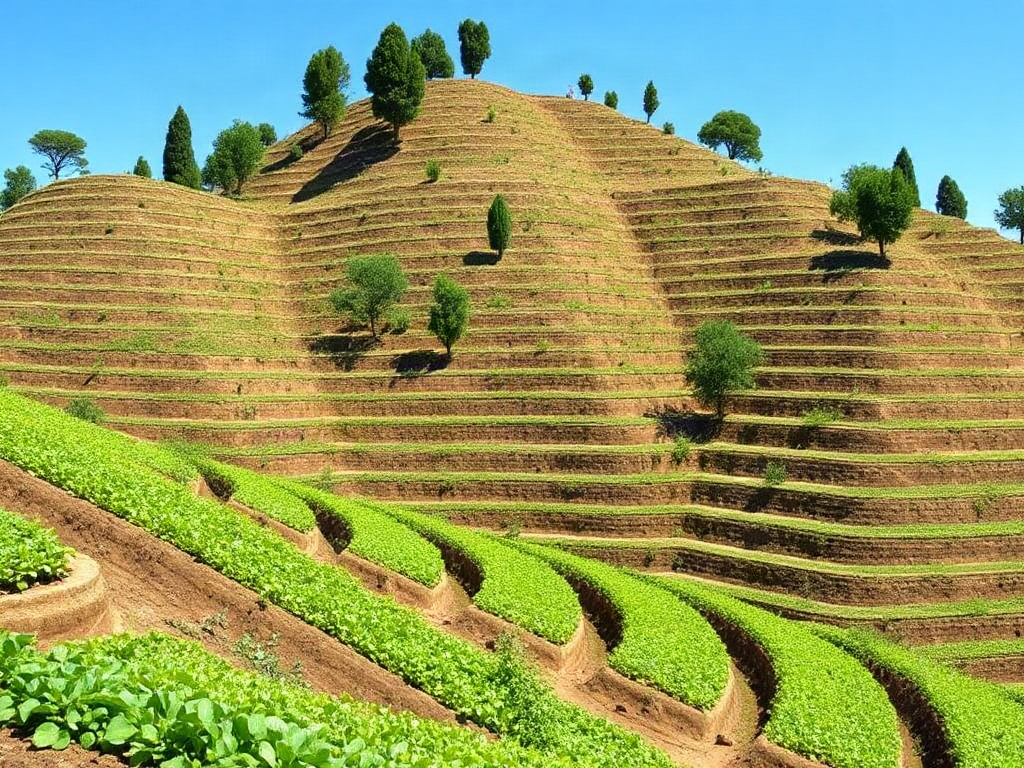
Terrace farming in Inca civilization and modern applications connects an Andean system of stepped fields with present-day methods for controlling runoff, conserving soil, and cultivating steep ground. Inca builders shaped hillsides with retaining walls, layered fill, drainage channels, and irrigation works suited to local elevations and water supplies. Modern growers can apply the same principles through contour-aligned beds, stable risers, protected outlets, and crops matched to terrace depth and exposure. The design is most useful where erosion and uneven moisture limit production, but poorly drained fill, undersized spillways, or overloaded retaining walls can turn a productive slope into an unstable one.
How Inca Terraces Managed Steep Andean Land
Inca terraces converted portions of rugged Andean slopes into level or gently graded planting surfaces while reducing the speed at which water and soil moved downhill. A terrace was not merely a flat shelf cut into a mountain. Its performance depended on the relationship among the retaining face, the material behind it, the cultivated surface, and the route by which excess water left the field.
Many surviving Andean terraces use stone retaining walls, although construction varied with local geology, labor, climate, and purpose. Behind a wall, builders could place coarse stone and progressively finer material beneath the cultivated soil. That arrangement promoted drainage and reduced the pressure that saturated earth placed against the wall. Not every terrace followed an identical formula, and it is misleading to treat the entire Inca realm as one standardized engineering project. Communities worked with different rainfall patterns, elevations, soils, and inherited agricultural landscapes.
The stepped form also made field labor and crop management possible on slopes that would otherwise shed water rapidly or be difficult to cultivate. Shorter slope lengths meant runoff had less distance to accelerate. Level planting areas retained more moisture than an uninterrupted incline, while defined channels and outlets could direct surplus water away from vulnerable walls. Terraces near settlements or administrative centers could support intensive management, but their construction and repair demanded substantial labor.
The familiar image of mountains covered in perfect green steps can obscure that tradeoff. Terracing does not create fertile soil automatically, and a retaining wall alone does not control water. Productive surfaces required suitable topsoil, organic inputs, planting decisions, and continued maintenance. Abandoned drains could clog, walls could deform, and cultivation could decline when the labor needed to maintain the system was unavailable.
For a modern reader, the durable lesson from Terrace farming in Inca civilization and modern applications is that slope management is a complete system. The wall, soil profile, water source, overflow route, and maintenance schedule must work together. Copying the appearance without reproducing those functions produces raised platforms, not dependable agricultural terraces.
Water, Soil, and Microclimates Within the Terrace System
Water control was the operating mechanism that made many Inca terraces useful rather than merely impressive. In dry highland settings, canals could bring water from springs, streams, or other dependable sources. On wetter sites, drainage and safe overflow mattered more than retaining every drop. The correct objective was controlled movement: enough infiltration for crops, but no prolonged saturation behind a retaining wall.
A terrace interrupts the direct downhill path of runoff. Water spreads across a shorter, flatter surface, which gives it more time to enter the soil. Coarse subsurface material may carry excess moisture toward an outlet, while the upper soil holds water and nutrients around crop roots. If the cultivated layer is compacted, however, water may pond on top or find a concentrated path through the riser. Both outcomes can undermine the structure.
Terraces can also create small differences in growing conditions. Wall material, orientation, elevation, wind exposure, and cold-air movement affect soil temperature and moisture. A sun-facing stone wall may absorb heat during the day, while shaded or low-lying positions may stay cooler. The archaeological site of Moray is often discussed in relation to Inca agricultural experimentation and microclimates, but its exact functions should not be reduced to a single unqualified claim. It is safer to view it as evidence of sophisticated landscape design than as proof that every terrace served as a controlled crop laboratory.
Soil depth remains a practical constraint. Shallow soil over coarse fill dries quickly and limits deep-rooted plants. Excessively deep fine soil retains more water but adds weight and may drain slowly. Organic matter improves aggregation and water-holding capacity in the root zone, yet large amounts of loose compost should not be mistaken for structural fill. It settles as it decomposes and can leave depressions that redirect water toward the wall.
A useful field check is to observe a terrace during moderate rain or irrigation. Water should infiltrate broadly or travel through an intended channel without cutting rills, pooling against the riser, or spilling over an unprotected edge. Cloudy seepage carrying fine sediment indicates internal erosion. A dry wall face is not proof of sound drainage, but new wet patches, bulges, or soil loss deserve prompt attention.
What Modern Growers Can Adapt—and What They Should Not Copy Blindly
Modern applications work best when growers adopt the Inca principles of contour, drainage, and site-specific construction rather than attempting to reproduce monumental stonework. A household garden on a mild slope may need only low, broad terraces stabilized with vegetation. A steep site carrying deep soil requires engineered retaining structures, dependable drainage, and professional assessment because wall failure can injure people and damage buildings below.
Contour-aligned growing areas are the most transferable feature. Setting beds across the slope shortens runoff paths and makes irrigation more even. Low earthen risers may suit gentle ground where soil is cohesive and permanent vegetation protects exposed surfaces. Timber can create quick garden terraces but eventually decays, especially where it remains damp. Dry-stacked stone drains readily and can be repaired in sections, although it demands suitable rock, careful placement, and a stable base. Masonry or modular retaining systems may carry greater loads, but they still need drainage and must meet applicable local requirements.
Terraces are not automatically the best response to every incline. Contour swales, perennial ground cover, orchard rows, or leaving a sensitive slope undisturbed may control erosion with less excavation. A grower who needs annual vegetable beds may value level working surfaces; someone establishing fruit trees on a moderate slope may obtain better results from smaller planting benches and permanent understory vegetation. Disturbing an already stable hillside simply to create a historic-looking garden can increase erosion during construction.
Water availability changes the decision as well. Traditional Andean systems often existed within communal networks of canals, labor, and maintenance. A modern property with a seasonal well or limited roof catchment cannot assume that terracing will solve water scarcity. Terraces improve how water behaves on a slope, but they do not create a supply. Irrigation lines should deliver water slowly and evenly, with valves that allow each level to be controlled. Sending a strong flow onto the highest bed and relying on overflow can scour lower levels.
The modern value of Terrace farming in Inca civilization and modern applications therefore lies in disciplined adaptation. Start with the smallest intervention that provides a stable planting surface and controlled drainage. Increase structural complexity only when slope angle, soil depth, crop use, and water movement justify the added expense and maintenance.
A Practical Terrace Planning Sequence for Sloping Ground
A safe terrace plan begins with observation of the whole slope, especially what lies above and below the proposed beds. Water entering from a road, roof, neighboring parcel, or natural drainage line can overwhelm a structure sized only for rainfall landing on the terrace itself. Utilities, septic components, unstable soil, and nearby foundations may rule out excavation or require qualified design.
Map contours before choosing wall locations. A simple water level or laser level can help identify equal-elevation points on a modest garden site, but measurement does not replace geotechnical or structural advice on consequential slopes. Place terraces so that runoff reaches protected outlets rather than concentrating at the end of a wall. Avoid discharging water onto bare soil or a neighbor’s property.
- Read the site in wet conditions. Mark ponding, springs, rills, sediment deposits, and existing flow paths.
- Test the soil profile. Note topsoil depth, compacted layers, stones, and whether subsoil drains slowly or collapses when wet.
- Choose the least disruptive form. Compare low vegetated steps, planting benches, and retaining walls against a no-excavation option.
- Design drainage before fill. Establish where intercepted water enters, crosses, and safely leaves each level.
- Build and plant in manageable stages. Stabilize one section and observe it through rainfall or irrigation before expanding.
During construction, preserve topsoil separately so it can be returned to the planting surface. Structural fill should be placed in appropriate layers rather than dumped loosely behind a wall. Keep heavy equipment and stockpiled soil away from an unfinished edge; added weight can trigger movement. Newly exposed soil should not remain bare through a wet season, so temporary mulch, erosion-control fabric suited to the site, or quick vegetation may be needed.
A practical first project is a low terrace for herbs or compact vegetables on a gentle garden slope, where failure would not threaten a house, road, or occupied area. This allows the grower to evaluate irrigation distribution, settlement, and maintenance effort. By contrast, a tall wall below a driveway or uphill from a dwelling has consequences far beyond crop production and belongs in the hands of qualified local professionals.
Success is visible when surfaces remain even, outlets pass water without scour, and risers hold their alignment after wet periods. Settlement confined to loose topsoil may be correctable. Rotation, cracking, outward bowing, fresh sinkholes, or persistent muddy discharge suggest a structural or drainage problem, not a cosmetic flaw.
Crop Choices, Maintenance, and Signs of Failure
Crop selection should follow the terrace’s soil depth, sunlight, access, and water capacity. Deep, stable beds can accommodate potatoes, maize, beans, squash, and other annual crops associated with Andean agriculture, provided the local climate suits them. Modern growers are not limited to historically Andean plants: leafy greens, culinary herbs, strawberries, or compact bush crops may fit small terraces better than sprawling or deep-rooted species.
Place thirsty crops where irrigation is dependable rather than assuming lower terraces will always receive enough seepage from above. Lower levels may be wetter, but that pattern can reverse when drains bypass the root zone or when a wall casts shade. Monitor each bed separately. A moisture check several inches below the surface gives more useful information than judging by the appearance of the topsoil.
Perennial plants can reinforce low earthen risers, but large woody roots near retaining walls may create future conflicts. Trees also add wind loading and become difficult to remove without disturbing the structure. Keep access in the design: narrow terraces that cannot be reached without stepping on cultivated soil become compacted, while walls hidden by dense growth are hard to inspect.
Maintenance should focus on water paths before planting convenience. Clear channels and protected outlets, replace displaced stones, fill animal burrows appropriately, and repair small erosion scars before they enlarge. Do not seal every visible gap in a dry-stone wall; some openings may allow drainage. Conversely, a stream of soil-laden water through the face signals loss of fine material and requires investigation.
Warning signs include leaning risers, widening joints, saturated bands, repeated ponding, gullies at terrace ends, and crops declining in isolated wet patches. Wilting despite regular irrigation may indicate shallow soil or water bypassing the roots, while yellowing and soft growth can accompany prolonged saturation. The response should address water movement and soil condition rather than simply adding fertilizer.
A seasonal record strengthens decisions. Photograph wall lines from fixed points, note where water travels during storms, and record irrigation duration and crop performance by level. That evidence reveals gradual movement that daily observation may miss. It also turns Terrace farming in Inca civilization and modern applications into a working land-management practice rather than a decorative reference to the past.
Frequently Asked Questions
Why did the Inca build agricultural terraces?
Terraces created cultivable surfaces on steep ground, shortened runoff paths, reduced soil movement, and helped communities manage irrigation and drainage across varied Andean elevations.
Did all Inca terraces have the same layered construction?
No. Materials and designs varied by location, geology, water conditions, period, and intended use. A single stone-and-gravel diagram should not be treated as universal.
Can a homesteader build terraces without stone walls?
Low vegetated risers or compact planting benches may suit gentle slopes. Steeper ground, deep fill, or locations near buildings generally require more rigorous design and may require professional input.
What is the most common cause of terrace failure?
Uncontrolled water is a frequent driver. Clogged outlets, saturated fill, concentrated overflow, and runoff arriving from uphill can erode soil or place excessive pressure on retaining structures.
Which crops work well on modern garden terraces?
Choose crops by soil depth and exposure. Herbs and greens suit shallow beds, while potatoes, beans, maize, squash, berries, and some perennial crops need adequate rooting space, water, and access.
Conclusion
Inca terraces endure as evidence of careful coordination among landform, water, soil, crops, and human labor. Their strongest modern lesson is functional rather than visual: shorten runoff paths, provide stable growing surfaces, route excess water safely, and maintain every level as part of one connected system. A small grower should first watch the slope during wet weather, identify incoming drainage, test the soil, and compare low-impact contour beds with structural retaining options. Start modestly where failure carries little risk, then monitor settlement, seepage, erosion, and crop response before expanding. Tall walls, unstable ground, concentrated runoff, or nearby buildings raise the consequences and warrant qualified local assessment. A terrace succeeds when it remains stable and workable through changing seasons—not merely when it resembles an ancient Andean landscape.