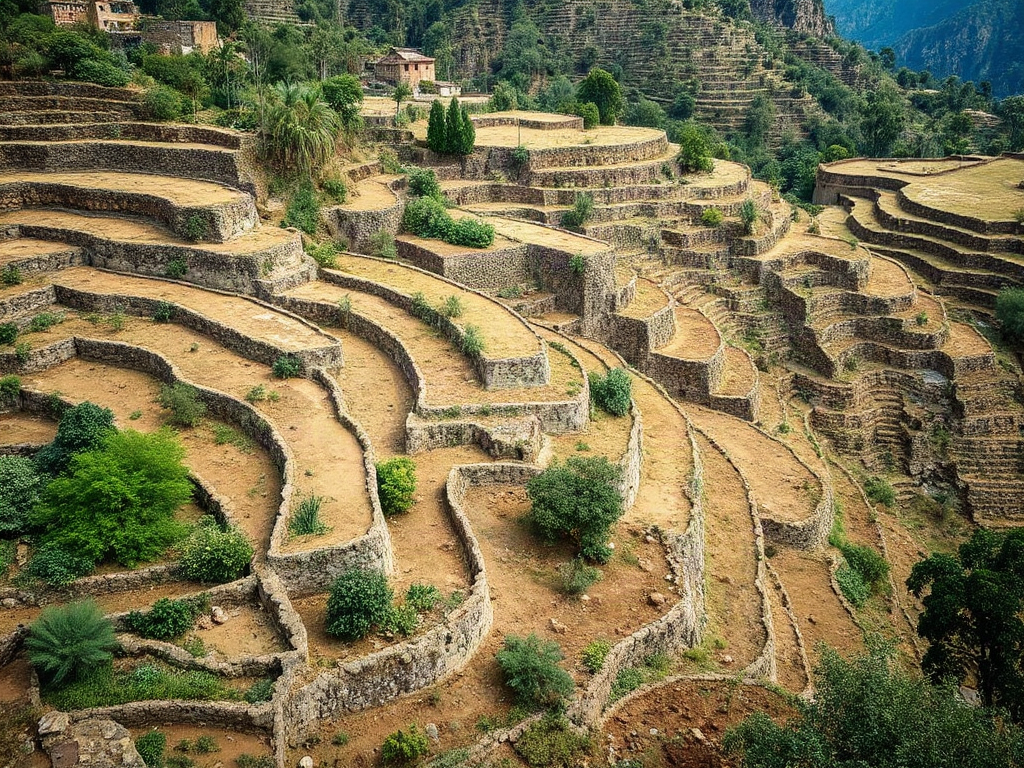
Inca farming methods worth understanding today include stone-supported terraces, carefully directed water, elevation-based crop placement, and raised fields that moderated difficult growing conditions. Terraces slowed runoff and retained cultivable ground, while canals distributed mountain water without assuming every plot needed the same amount. Farmers reduced crop risk by growing potatoes, maize, quinoa, and other plants in ecological zones suited to their temperature and moisture needs. The practical lesson is not to copy an ancient structure blindly, but to match earthworks, drainage, crop diversity, and maintenance to the contours and climate of a particular site.
Terraces Turned Steep Slopes Into Managed Growing Spaces
Andean terraces were engineered growing surfaces rather than simple steps cut into a hillside. Retaining walls held back the slope, and the ground behind them could contain layers of stone, coarse material, and cultivable earth arranged to manage drainage and support crops. By shortening a long slope into a series of flatter plots, terraces reduced the speed at which rainwater moved downhill and limited the amount of sediment it could carry away.
The walls and fill worked as a connected system. A stable retaining wall resisted the outward pressure of wet earth, while permeable material allowed excess water to move rather than collect behind the masonry. The flatter planting surface gave water more time to soak in. Stone could absorb heat during sunny periods and release some of it after temperatures fell, although the effect depended on wall exposure, local weather, and terrace geometry. Terraces did not erase mountain cold or create uniformly warm plots.
A useful modern comparison is the difference between a true agricultural terrace and a decorative retaining wall. A wall built without adequate foundation, drainage, or a safe outlet may bulge after repeated saturation. Likewise, a level bed that intercepts runoff but has nowhere to release overflow can become waterlogged or fail during a heavy storm. Historical terrace landscapes required inspection and repair; their durability should not be mistaken for maintenance-free construction.
For a sloping homestead, the transferable principle is to slow water and protect soil without concentrating pressure in an unsafe place. Begin by observing where runoff enters, crosses, and exits the site. Shallow contour beds, vegetated strips, or professionally designed terraces may be appropriate depending on slope, soil depth, rainfall, and the consequences of failure. Major excavation on a steep slope demands more engineering judgment than a low garden bed.
Signs that a modest contour intervention is working include reduced rilling, stable edges, even infiltration, and no persistent saturation behind barriers. Cracks, leaning walls, muddy seepage, exposed roots, or new gullies below the work indicate that water or soil pressure is being redirected badly. The enduring value of Inca farming methods worth understanding today lies in treating slope, structure, and drainage as one problem rather than three separate tasks.
Water Systems Balanced Irrigation With Drainage
Inca and earlier Andean waterworks moved water through canals, channels, reservoirs, and field-level distribution features suited to sharply varied terrain. Their function was not merely to deliver the largest possible volume. Water had to reach cultivated areas at a manageable rate, cross uneven ground, and leave fields without washing away valuable earth or saturating root zones.
Gravity made distribution possible, but it also created risk. A channel that descended too quickly could erode its bed and damage the ground below. One that was too flat could collect sediment or fail to reach its destination reliably. Branches and controlled outlets divided flow among plots, while routine clearing kept deposited material and vegetation from changing channel capacity. The operating lesson is as important as the construction: a water system remains dependable only when someone watches how it behaves.
Consider a garden below a roof-fed tank. Sending the tank outlet directly into one upper bed may drown that bed while leaving lower crops dry. A better adaptation uses a controlled outlet, modest flow, several distribution points, and an overflow route that remains stable during an unexpected surge. Mulched basins or level planting rows can then hold water near roots. This resembles the logic of managed gravity irrigation without pretending that a backyard system reproduces an imperial Andean canal network.
Drainage deserves equal priority. Raised fields used in parts of the Andes elevated crops above adjacent channels, improving control where flat, wet, or frost-prone ground made ordinary planting difficult. Water beside raised planting platforms could influence local moisture and temperature conditions, while excavated channel material helped maintain the beds. Such fields are often discussed alongside Inca agriculture, but many Andean techniques predated the Inca and continued through different communities. Credit should therefore extend beyond a single state or period.
A compact water check before altering a site should cover four points:
- Source: Determine whether the supply is seasonal, continuous, or storm-driven.
- Rate: Release water slowly enough that the receiving ground can absorb it.
- Route: Stabilize bends, drops, and outlets where erosion is most likely.
- Overflow: Provide a safe destination when storage or channels exceed capacity.
Pooling around crop crowns, collapsing channel edges, sediment fans, and dry lower beds all reveal distribution problems. The correct response is usually to adjust flow and grade before adding more water. Productive irrigation is controlled movement, not maximum delivery.
Elevation and Crop Diversity Spread Agricultural Risk
Andean agriculture used environmental differences rather than treating them solely as obstacles. Changes in altitude, slope orientation, frost exposure, moisture, and soil created distinct growing conditions over comparatively short distances. Communities cultivated and exchanged crops across these zones, placing plants where their requirements and tolerances made sense.
Maize generally needed different conditions from hardy tubers, while potatoes and quinoa offered options for colder or higher settings. Numerous crop varieties further spread risk because they did not all respond identically to drought, frost, pests, or planting time. Diversity did not guarantee a harvest, but it reduced dependence on one crop encountering ideal weather in one field. Storage, especially the preservation of potatoes as chuño through freezing and drying processes in suitable highland conditions, extended the value of production beyond harvest day.
This differs from planting a single favored cultivar across every available bed. A uniform planting simplifies sowing and harvesting, yet the same cold snap, disease pressure, or moisture failure can affect the entire crop at once. A diversified homestead might place early potatoes in a well-drained bed, reserve a warmer location for maize, grow quinoa where conditions suit it, and keep more than one cultivar of a staple. The point is not to adopt crops solely because the Inca grew them. It is to assign crops according to microclimate and avoid one-point failure.
Mapping a property makes this principle actionable. On cold mornings, note where frost remains longest. After rain, mark both quickly drying ground and areas that stay wet. Record hours of direct sun, wind exposure, and the dates when shade changes. A low spot may be unsuitable for a frost-sensitive crop even if its soil looks rich, while a sun-facing wall may lengthen the useful season for a heat-demanding plant. These observations provide more decision value than a generalized hardiness map alone.
Success appears as crops matched to their locations, harvests spread across time, and fewer total losses when one plot performs poorly. Repeated failure of the same species in the same cold pocket signals a placement error rather than a need for more fertilizer. The broader insight behind Inca farming methods worth understanding today is that resilience comes from coordinated differences in fields, crops, varieties, and storage—not from expecting one intervention to control every hazard.
How to Apply Inca Principles Without Misusing Them
Modern growers should adapt the governing principles of Andean agriculture rather than copy visible features without their original context. A terrace, canal, or raised field developed for a particular combination of geology, labor, climate, and community management may perform poorly somewhere else. The first decision is therefore whether the site has the problem that the proposed feature actually solves.
Start with observation and the smallest reversible change. If runoff crosses a mild garden slope, test a short contour-aligned bed or a vegetated strip and watch it through several rains. If soil remains saturated, trial one raised planting area while preserving a safe outlet. If frost varies across the property, place inexpensive temperature sensors or simple minimum-maximum thermometers in contrasting locations before relocating perennial crops. Each trial should answer a site-specific question.
Scale only after checking the consequences. A sound sequence is to map contour and water movement, identify soil depth and unstable areas, choose a low-risk intervention, observe it through the harshest relevant season, and repair weaknesses before extension. Deep cuts, tall retaining structures, work near buildings, or changes that send water toward neighboring property call for qualified local advice and any required approvals. Ancient precedent does not replace current structural, drainage, or property obligations.
Labor is another constraint that romantic accounts often understate. Terraces need cleared drains, repaired edges, controlled vegetation, and renewed soil fertility. Channels collect sediment. Diverse plantings complicate seed management and harvest schedules. A smaller system that receives regular attention is more useful than an ambitious earthwork that deteriorates after its first wet season. Compare the yearly maintenance burden with the value of the soil or water being protected before committing to construction.
Cultural accuracy matters as well. Agricultural knowledge in the Andes was built by many societies and remains active among Indigenous communities; not every terrace or raised field should be labeled exclusively Inca. Archaeological remains are not templates to excavate, alter, or imitate on protected land. Readers researching Inca farming methods worth understanding today should distinguish historical interpretation from present-day Andean practice and seek regionally grounded sources when possible.
A successful adaptation produces measurable site improvements: less exposed sediment after storms, controlled overflow, crops placed in better microclimates, and a maintenance schedule the household can sustain. Failure shows up as concentrated runoff, unstable retaining edges, chronically wet roots, or work that depends on constant emergency repair. Those signals should prompt redesign, not additional stone, water, or excavation.
Frequently Asked Questions
What was the main purpose of Inca agricultural terraces?
Terraces created more manageable planting surfaces on slopes, slowed runoff, retained earth, and supported controlled movement of water. Their retaining walls, fill, drainage, and upkeep functioned together.
Did the Inca invent all Andean terrace and raised-field agriculture?
No. Many techniques developed before the Inca and were practiced by multiple Andean societies. The Inca expanded, organized, or maintained agricultural systems while drawing on a much longer regional history.
Can a home gardener copy an Inca terrace?
A gardener can apply contour management, drainage, and soil-retention principles, but a steep or tall terrace requires site-specific structural judgment. Begin with small, low-risk work and obtain qualified help where failure could cause harm.
Which crops are associated with Inca agriculture?
Potatoes, maize, and quinoa are prominent examples, alongside other tubers, grains, legumes, and regionally adapted plants. Crop choice varied with elevation, moisture, temperature, and local food needs.
What is the most useful Inca farming lesson for a homestead?
Match each intervention to the site. Observe slope, runoff, drainage, frost pockets, and crop performance before building permanent earthworks or relying heavily on one field or cultivar.
Conclusion
The strongest modern lesson from Andean agriculture is disciplined adaptation to place. Retaining walls worked because their foundations, fill, drainage, and water routes were coordinated. Crop diversity worked because plants and varieties were distributed across distinct growing conditions, while storage reduced dependence on immediate consumption. A homesteader should begin by mapping runoff, wet ground, frost pockets, sunlight, and existing erosion, then test one modest intervention through the season that challenges it most. Expand only when the change controls water without shifting damage downhill and when its maintenance fits available labor. Treat large slope modifications as structural projects, not garden decoration, and recognize that the agricultural knowledge associated with the Inca also reflects older and continuing Andean traditions.