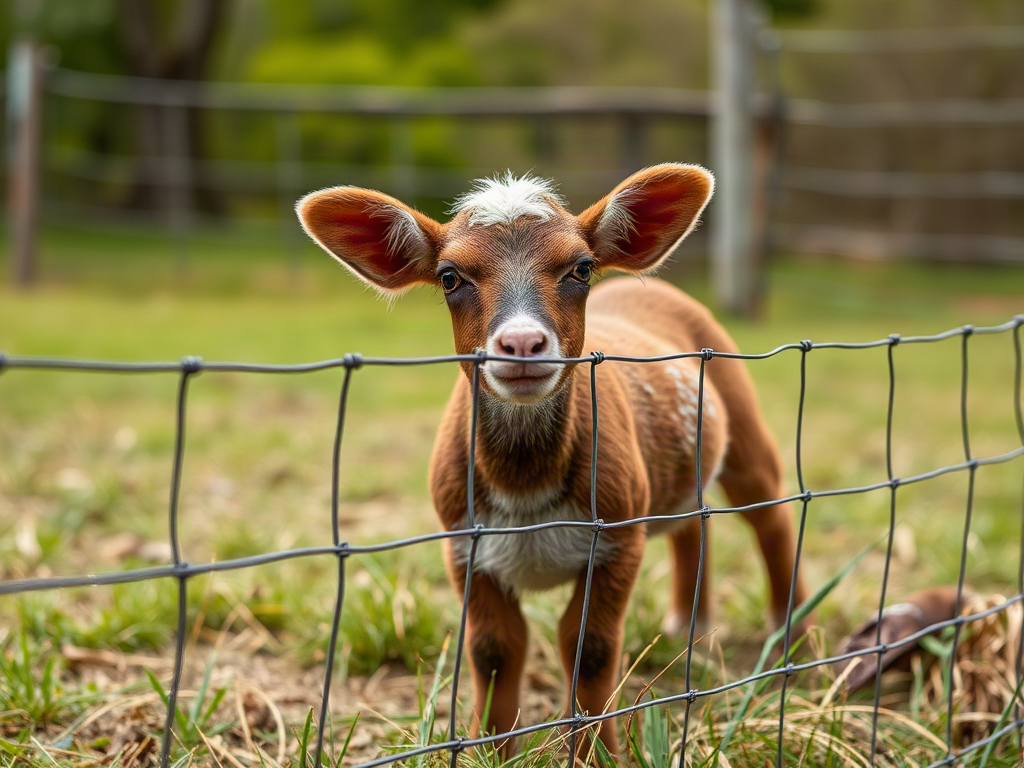
Safe fencing options for small homestead animals include small-mesh welded wire, properly sized woven wire, and carefully installed electric offsets, selected according to the animal’s size, climbing ability, and likely predators. Secure fencing needs openings too small for heads and legs, smooth or protected edges, a firm bottom that prevents digging, and gates that latch reliably. Poultry, rabbits, goats, and young sheep may need different mesh dimensions and fence heights, while electric fencing should supplement—not replace—physical containment for animals that could become tangled. Inspect low spots, corners, tension, vegetation, and gate hardware regularly because ordinary wear often creates the first escape or entanglement hazard.
Match Mesh and Height to the Animal
Fence safety begins with the animal’s body size and behavior, not with a material chosen from a hardware-store shelf. A rabbit can push through an opening that contains a young chicken, while a goat may catch its horns in mesh designed for poultry. Small animals also change size quickly, so a fence that is suitable for chicks or lambs may become unsafe as they mature.

For poultry, small welded wire or hardware cloth is often useful around a coop, brooder run, or lower wall because the openings are difficult for chicks to pass through and offer fewer opportunities for a head or foot to become trapped. Larger poultry runs may use poultry netting for overhead or temporary areas, but lightweight netting alone may not withstand dogs, raccoons, or determined birds. Rabbits need openings small enough to prevent the head from entering, with a roof or covered top where jumping predators are present.
Goats and sheep require a different approach. Their enclosure must resist leaning, rubbing, climbing, and repeated pressure at corners. A small-mesh livestock panel may contain young animals more reliably than wide-opening field fence, but every cut end needs protection because sharp wire can injure faces, ears, and flanks. For miniature breeds, do not assume that a fence marketed for livestock is automatically appropriate; the opening dimensions may still be large enough for a head or leg to pass through.
Height matters most when an animal jumps, climbs, or uses nearby objects as leverage. A low fence may work for a supervised poultry yard but fail once feed bins, stacked lumber, or branches sit beside it. Before buying materials, observe the animal’s escape behavior and identify the smallest individual in the group. A practical choice should contain that animal without relying on constant supervision. For broader husbandry planning, connect enclosure design with the recommendations in Safe Fencing Options for Small Homestead Animals.
Compare Fencing Materials and Their Tradeoffs
Welded wire, woven wire, hardware cloth, plastic netting, and electric fencing each solve a different containment problem. The safest choice is usually a combination: rigid or tightly secured physical mesh for containment, reinforced areas where predators attack, and an electric offset only where it can be installed without creating an entanglement risk.
Hardware cloth offers small openings and a firm surface, making it practical for rabbit hutches, chick enclosures, and the lower portions of poultry runs. Its limitations are cost, weight, and the need to fasten it with substantial staples, screws, or washers. Thin staples can pull free when a predator pushes against the mesh. Galvanized material may last longer in damp conditions, but all fasteners and cut edges still deserve inspection.
Welded wire panels are rigid and easy to position, which helps create straight walls that do not sag into animal-accessible loops. They are convenient for temporary pens and small goat or sheep yards. Their weakness is the opening pattern: a panel with wide squares may allow a young animal to insert its head, while a narrow panel may be harder to cut or reposition. Covering the lower section with smaller mesh can provide a safer transition as animals grow.
Woven wire follows uneven ground better than rigid panels and can be useful for larger runs. It must remain properly tensioned, because loose sections form pockets where legs can catch. Plastic poultry netting is light and easy to move, but it can sag, tear, and become difficult to see in grass; it is better suited to supervised, low-pressure applications than to a permanent predator barrier.
A common mistake is choosing the cheapest roll based only on its total length. Compare the complete installed system: posts, bracing, staples, gates, buried or folded edges, and replacement costs. A shorter run made from durable, correctly sized mesh may be safer and less expensive over time than a large enclosure that requires constant patching. Browse related Safe Fencing Options for Small Homestead Animals decisions before expanding the perimeter.
Build Safer Bottom Edges, Corners, and Gates
Most fencing failures begin at transitions rather than in the middle of an intact wall. Uneven ground creates gaps below the fence, corners loosen under animal pressure, and gates often leave openings larger than the surrounding mesh. Small animals investigate these weak points repeatedly, especially when feed, water, shade, or companions are on the other side.
For digging species such as rabbits and some poultry predators, extend mesh below ground or create an outward-facing apron that lies flat and is anchored securely. The goal is to make digging at the fence line unproductive rather than to rely on a shallow trench that gradually fills with soil. Check the edge after heavy rain because runoff can expose buried mesh and create a new gap. Avoid leaving protruding wire at the bottom; a buried edge or folded apron should be smooth and firmly held.
Corner posts need more support than intermediate posts because animals push into corners when turning or attempting to escape. Brace end and gate posts so they remain upright when the gate is opened, shut, or used as a resting point. Where rigid panels meet, overlap them without leaving a triangular gap. Tie points should be secure and trimmed so loose wire cannot form a loop around a leg, neck, or horn.
Gates deserve a separate safety check. A spring latch may be convenient, but some animals learn to lift or push it. Use a latch that cannot be operated from inside the enclosure, and consider a secondary clip or carabiner where children, pets, or wildlife could disturb the primary closure. Keep gate clearance low enough to prevent crawling underneath, while allowing enough room for the gate to swing freely over mud, snow, and bedding.
The weak assumption is that a fence is safe because no animal has been injured yet. Test it from the animal’s perspective: look for head-sized openings, sharp cut ends, loose bottom wire, climbable objects, and corners that flex under pressure. Correcting these details before stocking the enclosure is easier than treating an injured animal or chasing an escapee through a garden.
Use Electric Fencing and Predator Protection Carefully
Electric fencing can discourage goats, sheep, dogs, and some wildlife from pressing against a physical barrier, but it should not be treated as a stand-alone answer for every small animal. A startled rabbit, chick, or young goat may run into an electrified strand and become tangled, particularly where netting sags or vegetation obscures the wire. Physical mesh should provide the primary containment whenever an animal could become caught.

An electric offset placed outside a sturdy fence may reduce climbing and nose-to-wire contact by teaching larger animals to keep distance from the boundary. It works best when the strand is visible, vegetation is controlled, and the energizer and grounding system are maintained according to the manufacturer’s instructions. A poorly grounded or overgrown line may deliver inconsistent performance, causing animals to test it repeatedly. That behavior can turn a manageable boundary into a persistent escape problem.
Predator protection also depends on the height and placement of the barrier. Raccoons may climb ordinary poultry fencing, dogs may dig beneath it, and hawks may reach open-topped runs. A covered poultry run, secure night housing, and smaller mesh near the ground can address different risks more effectively than simply adding height. For rabbits, a solid or mesh roof may be as important as the side walls because climbing and digging predators attack from different directions.
Electric netting can be practical for movable grazing areas, but it needs frequent observation during the first hours after installation. Animals may test the perimeter, and grass can bend strands toward the ground. Keep netting away from water troughs, brush, metal gates, and places where animals crowd. Never use improvised wiring or damaged components. If the enclosure serves poultry, rabbits, or very young stock, a rigid inner barrier is generally a more forgiving choice than electrified mesh alone.
Inspect the Enclosure Before and After Occupancy
A pre-use inspection should be systematic rather than a quick walk around the outside. Open and close every gate, press on each corner, examine the lowest edge, and inspect the inside where an animal will rub, jump, or lie down. Bright daylight makes holes easier to see, but a flashlight held low across the mesh can reveal loops, lifted edges, and gaps that blend into the background.
Use this compact inspection sequence before moving animals in:
- Measure openings at corners, under gates, and where two materials meet.
- Run a gloved hand along accessible edges to find sharp points or broken welds.
- Check posts for movement and confirm that gate hardware cannot be lifted from inside.
- Remove objects that create launch points, including stacked boards, buckets, and low branches.
- Inspect buried edges and aprons after rain, frost, digging, or soil movement.
- Look for predator access above the walls, especially around coop roofs and run covers.
After stocking the enclosure, watch behavior rather than waiting for visible damage. Repeated pacing along one section may indicate a gap, a tempting food source outside, or pressure from a predator. A goat rubbing its shoulder on a panel may loosen posts; chickens gathering beneath a fence may expose soil; rabbits chewing or digging at one corner may need a buried barrier or a change in enrichment and layout.
Maintenance frequency depends on weather, species, and fence type. Flexible netting needs attention after wind, while rigid panels may fail at fasteners or posts. Keep a small repair supply on hand: matching mesh, sturdy fasteners, gloves, pliers, and a temporary barrier. Repair damage before releasing animals into the area again. A visually neat fence is not necessarily safe, but a regularly tested fence gives small homestead animals a much lower chance of escape, entanglement, or predator contact.
For region-specific livestock enclosure guidance, consult publications from a nearby land-grant university extension, state agriculture department, or local conservation agency. Their recommendations may address soil conditions, predator pressure, weather exposure, and species-specific containment in ways that a general hardware product label cannot.
Frequently Asked Questions
What mesh size is safest for small poultry?
Use mesh small enough that chicks cannot pass through or insert their heads and feet. Hardware cloth is often more secure than wide poultry netting around the lower run and brooder areas.
Can welded wire contain goats?
It can, provided the openings and panel height suit the goats’ size and climbing behavior. Reinforce corners, protect cut ends, and avoid patterns that allow a goat to trap its head or horns.
Should fencing be buried for rabbits?
Yes, a buried edge or securely anchored outward apron may reduce digging escapes. Inspect it after rain and digging because exposed or lifted mesh can create both an escape route and an injury hazard.
Is electric netting safe for small animals?
It may be appropriate for some supervised applications, but sagging or poorly maintained netting can entangle animals. Use a physical barrier as the main enclosure and keep electrified strands visible and clear of vegetation.
How often should an animal fence be checked?
Inspect it before occupancy and after storms, heavy rain, frost, digging, or animal behavior changes. High-pressure areas such as gates, corners, and low edges usually need more frequent checks than straight fence runs.
Conclusion
A dependable enclosure matches the mesh, height, bottom edge, and gate design to the particular animal rather than relying on a universal fence product. Small openings protect chicks and rabbits from slips and entrapment, while goats and sheep need strong panels, supported corners, and arrangements that do not invite climbing or horn capture. Predator protection may require roofs, buried edges, or an exterior electric offset, but electrified netting should not substitute for sound physical containment. Walk the enclosure from both sides before use, then monitor the animals for rubbing, digging, crowding, or repeated testing. Repair loose fasteners, exposed wire, sagging mesh, and gate gaps promptly. That routine does more for safety than simply selecting a heavier or more expensive material.