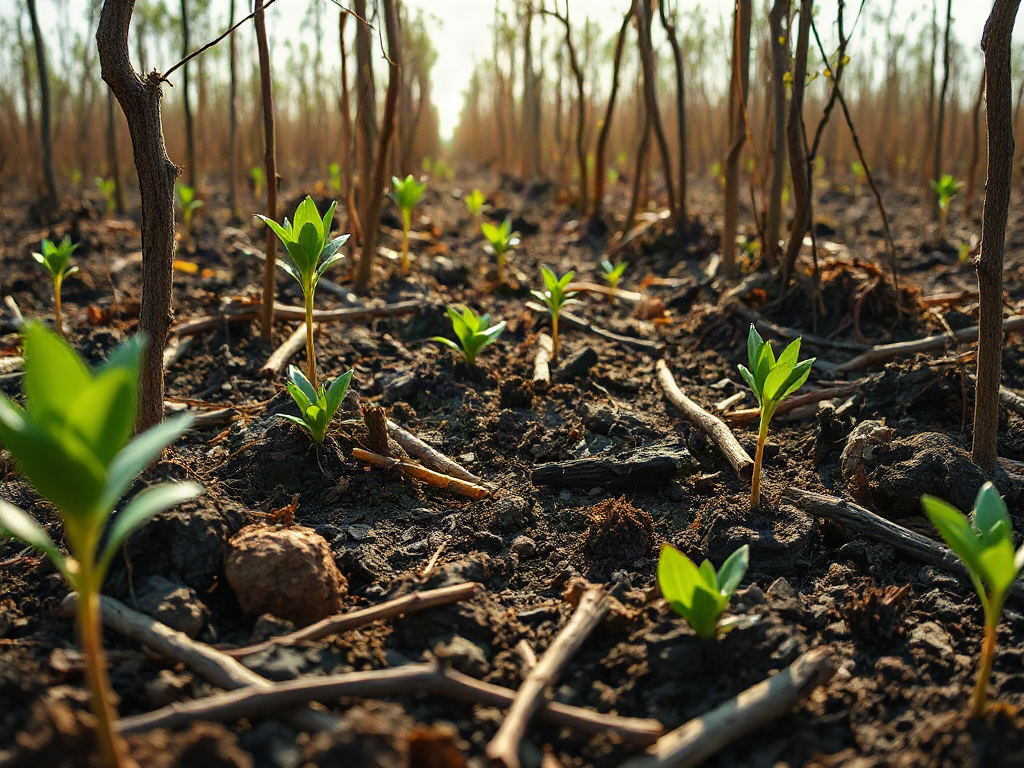
Slash-and-burn farming risks arise when repeated clearing and short fallow periods replace forest recovery, exposing soil to erosion, releasing stored carbon, and exhausting the brief nutrient pulse left by ash. Effective alternatives include agroforestry, planted fallows, mulch-based clearing, cover crops, and contour barriers that retain living roots and organic matter. Burning may produce a fast, low-cost planting window, but it rarely supplies durable fertility where land is reused frequently. The practical priority is to keep soil covered, return biomass to the field, slow runoff, and match each alternative to labor, rainfall, slope, and access to planting material.
How Slash-and-Burn Changes a Field
Fire converts standing vegetation and surface litter into ash, gases, and airborne particles within hours. Ash can temporarily raise soil pH and make some plant nutrients readily available, which helps explain the strong early growth sometimes seen after clearing. Heat also removes weeds and makes dense vegetation easier to plant through. Those immediate effects are real, but they are easily mistaken for lasting soil improvement.
The nutrient pulse is short because ash is exposed at the surface. Heavy rain may wash soluble nutrients below shallow roots or carry them downslope. Wind can remove fine ash before planting. Nitrogen stored in vegetation and litter is especially vulnerable because much of it is released into the atmosphere during combustion rather than retained in the field. Once the ash has dispersed, the system must depend on the soil’s remaining organic matter, nutrient reserves, and biological activity.
Traditional shifting cultivation and repeated burning are not identical. A rotational system with a long enough fallow may allow woody plants to return, rebuild biomass, protect the surface, and recover part of the nutrient stock before another clearing. Trouble develops when population pressure, insecure access to land, market demand, or limited acreage shortens that recovery period. A plot that once rested long enough to regain tree cover may be reopened while it still supports only grasses, shrubs, or depleted regrowth.
Soil structure also changes after vegetation is removed. Roots no longer reinforce aggregates or open channels for water infiltration. Intense heat can damage organisms near the surface, while the loss of canopy lets raindrops strike bare ground directly. On a slope, runoff may begin carrying the finest and most fertile particles away before a new crop forms a protective canopy. A flat field with deep soil and gentle rain therefore faces a different level of danger than a steep plot under seasonal downpours.
A common mistake is judging the practice from the first crop alone. A vigorous maize or cassava stand immediately after burning says little about whether the land can maintain yields through subsequent seasons. Better indicators include how quickly weeds return, whether rainfall forms crusts or rills, how much residue remains between rows, and whether the next crop requires more land or labor to achieve the same result. These mechanisms are central to evaluating Slash-and-burn farming risks and alternatives under actual field conditions.
The Main Risks to Land, Water, and Households
The most damaging risks appear when burning is frequent, boundaries are poorly controlled, or the cleared site cannot regenerate between crop cycles. Soil loss is often the first visible warning. Sheet erosion may remove a thin layer without attracting attention, while small channels indicate that runoff is already concentrating. Sediment moving into streams can cloud water, bury aquatic habitat, and transport nutrients beyond the field where they were needed.
Declining organic matter creates a slower but equally serious problem. Organic residues feed soil organisms, help particles form stable aggregates, and improve the soil’s ability to hold water. Burning repeatedly removes much of that material instead of allowing it to decompose in place. A field may then become harder when dry, muddier when wet, and less able to buffer crops through a rainless period. Adding mineral fertilizer may replace selected nutrients, but it does not by itself restore root channels, surface cover, or stable organic matter.
Fire escape is an operational risk rather than a distant environmental concern. Wind shifts, dry fuel outside the intended plot, smoldering logs, and incomplete firebreaks can move flames into neighboring vegetation, fencing, stored materials, or buildings. Smoke can reduce visibility and aggravate respiratory problems, particularly for workers close to the burn. Local burn restrictions, permits, and liability rules vary, so a landholder should consult the relevant fire authority rather than assume an agricultural fire is automatically permitted.
At the landscape scale, clearing woody vegetation removes habitat and releases carbon held in plants. Repeated conversion can fragment remaining forest and reduce the availability of useful wild foods, fuelwood, pollinator habitat, and other local resources. The impact depends heavily on what is burned: clearing secondary brush on an established plot is not equivalent to converting mature forest, peatland, or vegetation beside a stream.
Household economics can obscure these costs. Fire is attractive because it quickly handles bulky material with little equipment, while no-burn methods may demand more cutting, hauling, or carefully timed labor. Yet the apparent saving can reverse if declining fertility forces a family to clear another plot, buy more inputs, or spend additional time controlling aggressive weeds. A useful field inspection should check:
- Surface protection: bare patches, crusting, exposed roots, or ash movement after rain.
- Water flow: rills, sediment deposits, flooded lower rows, or muddy drainage outlets.
- Recovery capacity: weak regrowth, fewer useful trees, and shorter intervals before reclearing.
- Fire exposure: dry fuel near property lines, structures, roads, or neighboring fields.
The misconception to avoid is that every risk can be solved by a more carefully managed burn. Firebreaks and suitable weather may reduce escape risk, but they do not replace lost biomass or protect bare earth during later storms. Land condition, not simply flame control, must guide the decision.
Alternatives That Keep Land Productive
The strongest alternatives preserve useful vegetation, maintain ground cover, and return cut biomass to the soil. No single method suits every climate or crop. The workable choice depends on how much woody material must be handled, whether the site is sloped, how long the land will remain under cultivation, and whether labor or machinery is available.
Cut-and-Mulch Clearing
Cut-and-mulch systems leave chopped vegetation on the ground rather than burning it. The residue softens raindrop impact, reduces evaporation, suppresses some weeds, and gradually returns nutrients as it decomposes. Farmers can open narrow planting lines or pockets through the mulch instead of exposing the entire surface. This approach is particularly useful where erosion risk is high and decomposition is reasonably active.
The tradeoff is labor. Thick branches can obstruct hand tools, harbor some pests, or take years to break down. Material should be arranged so it does not block drainage or bury young plants. Woody stems may be stacked along contours, chipped where equipment is available, or retained in compact habitat piles away from crop rows. A common failure is creating a deep, matted layer directly over wet soil; poor airflow can delay planting and encourage uneven establishment.
Agroforestry and Improved Fallows
Agroforestry keeps selected trees or shrubs within and around cultivated ground. Deep roots can capture nutrients beyond the reach of annual crops, while prunings supply surface mulch. Species selection matters: a tree that competes heavily for light or water can reduce crop performance rather than improve it. Useful designs may include contour hedgerows on slopes, widely spaced multipurpose trees, streamside buffers, or a managed fallow planted with locally adapted nitrogen-fixing species.
An improved fallow accelerates recovery by establishing chosen plants instead of waiting for random regrowth. It still requires time outside annual production, however, and may not fit households that need every plot each season. Before introducing a species, verify that it is locally appropriate and not invasive. Seed availability, browsing livestock, pruning labor, and rights to harvested wood can determine whether the design survives beyond its first year.
Cover Crops, Rotations, and Contour Protection
Cover crops provide living cover between or after cash crops. Legumes may add biologically fixed nitrogen, while grasses often produce dense roots and durable residue. Mixtures can combine these functions, but they also complicate termination and seed management. On sloping ground, contour strips, grass barriers, and residue lines slow runoff; they work best when paired with covered soil rather than treated as stand-alone erosion cures.
A field moving away from burning does not need every alternative at once. A manageable transition might retain useful trees, cut remaining brush into contour-aligned piles, plant through mulch, and establish a cover crop after harvest. Readers comparing Slash-and-burn farming risks and alternatives should favor combinations that fit existing tools and can be repeated without depending on a one-time supply of outside inputs.
How to Choose and Introduce a Replacement Method
A replacement method should solve the field’s most limiting problem without creating an unmanageable labor burden. Begin by identifying whether the priority is erosion control, fertility recovery, weed suppression, woody-residue handling, or fire safety. Trying to optimize all five at once often produces an elaborate plan that cannot be maintained through planting and harvest.
Site conditions narrow the options. Steep or stream-adjacent land needs continuous cover and runoff control before yield-enhancing inputs. Dry areas need methods that conserve moisture without allowing mulch to become a severe fire fuel during the dry season. Wet sites require residue placement that does not trap water around crop crowns. Where termites, rodents, or crop diseases are concerns, test how retained biomass behaves before spreading it across the whole plot.
A small comparison area offers better evidence than assumptions imported from another climate. Divide a representative part of the field into manageable strips. Keep one strip under the current non-expansion practice, use cut mulch on another, and add a locally suitable cover crop or contour barrier on a third. Record labor hours, seed or tool costs, weed pressure, crop establishment, visible runoff, and soil cover after harvest. Yield matters, but a method that gives a similar harvest with less erosion and better residual cover may have the stronger long-term value.
Use the following order when planning a transition:
- Protect sensitive areas first. Exclude burning near streams, steep banks, property edges, and infrastructure where risk is difficult to contain.
- Retain valuable vegetation. Mark useful trees, windbreaks, shade, and stabilizing roots before cutting begins.
- Place biomass deliberately. Keep fine material as mulch and arrange coarse pieces where they slow runoff without blocking access.
- Add living cover. Choose a rotation, fallow plant, or cover crop suited to rainfall, crop timing, and available management.
- Measure recovery. Check infiltration, earthworm activity where locally meaningful, root depth, weed shifts, erosion marks, and yield across multiple seasons.
Success is visible when rain enters the ground rather than running across it, residue remains between rows, crop roots explore beyond the planting hole, and the plot does not require progressively heavier clearing. Warning signs include persistent bare patches, mulch that repeatedly obstructs planting, a cover crop that competes with the main crop, or hedgerows that spread beyond their intended space.
The weak assumption is that a no-burn system immediately requires expensive machinery. Hand-cut mulch, selective tree retention, narrow planting lanes, and small contour barriers can begin with modest tools, although they may require more labor at first. If labor is the binding constraint, convert one section per season rather than abandoning the approach after attempting the entire holding. More detailed evaluation of Slash-and-burn farming risks and alternatives should account for both field performance and whether the household can repeat the work reliably.
Frequently Asked Questions
Why does ash make crops grow well at first?
Ash rapidly releases certain mineral nutrients and may temporarily raise acidic soil pH. That response fades as nutrients are taken up, leached, eroded, or removed with the crop.
Is slash-and-burn the same as shifting cultivation?
No. Some shifting systems include long fallows that permit substantial vegetation recovery. Repeated burning with short recovery periods carries much greater depletion and erosion risks.
What is the simplest alternative for a small plot?
Selective cutting followed by planting through retained mulch is often a practical starting point. Test a limited area because residue volume, pests, rainfall, and available labor affect results.
Can fertilizer repair land damaged by repeated burning?
Fertilizer can replace particular nutrients, but it does not automatically restore organic matter, soil structure, biological activity, or erosion losses. Ground cover and biomass return remain necessary.
How long does a field take to recover?
Recovery time varies with soil depth, rainfall, erosion severity, remaining vegetation, and the fallow species used. Track cover, infiltration, regrowth, and crop performance rather than relying on a fixed timetable.
Conclusion
The strongest land-use decision is the one that protects the productive layer of the field while remaining feasible season after season. Treat a strong first crop after burning as a temporary response, not proof that fertility has been rebuilt. Give priority to steep ground, waterways, fire boundaries, and plots showing rills, crusting, weak regrowth, or rising weed pressure.
Start the transition on a representative section rather than changing the entire holding at once. Retain useful trees, position cut vegetation as protective cover, add an appropriate cover crop or managed fallow, and compare labor and field condition across several crop cycles. If runoff declines, cover persists, and yields remain workable without opening new land, the replacement is moving in the right direction. Local extension staff, forestry offices, and fire authorities can help refine species choices, erosion controls, and legal burn requirements.